ABG Interpretation for NCLEX: Patterns, Compensation and Six Cases
Learn to interpret arterial blood gases through six original cases, including expected compensation and mixed patterns that simple mnemonics can miss.
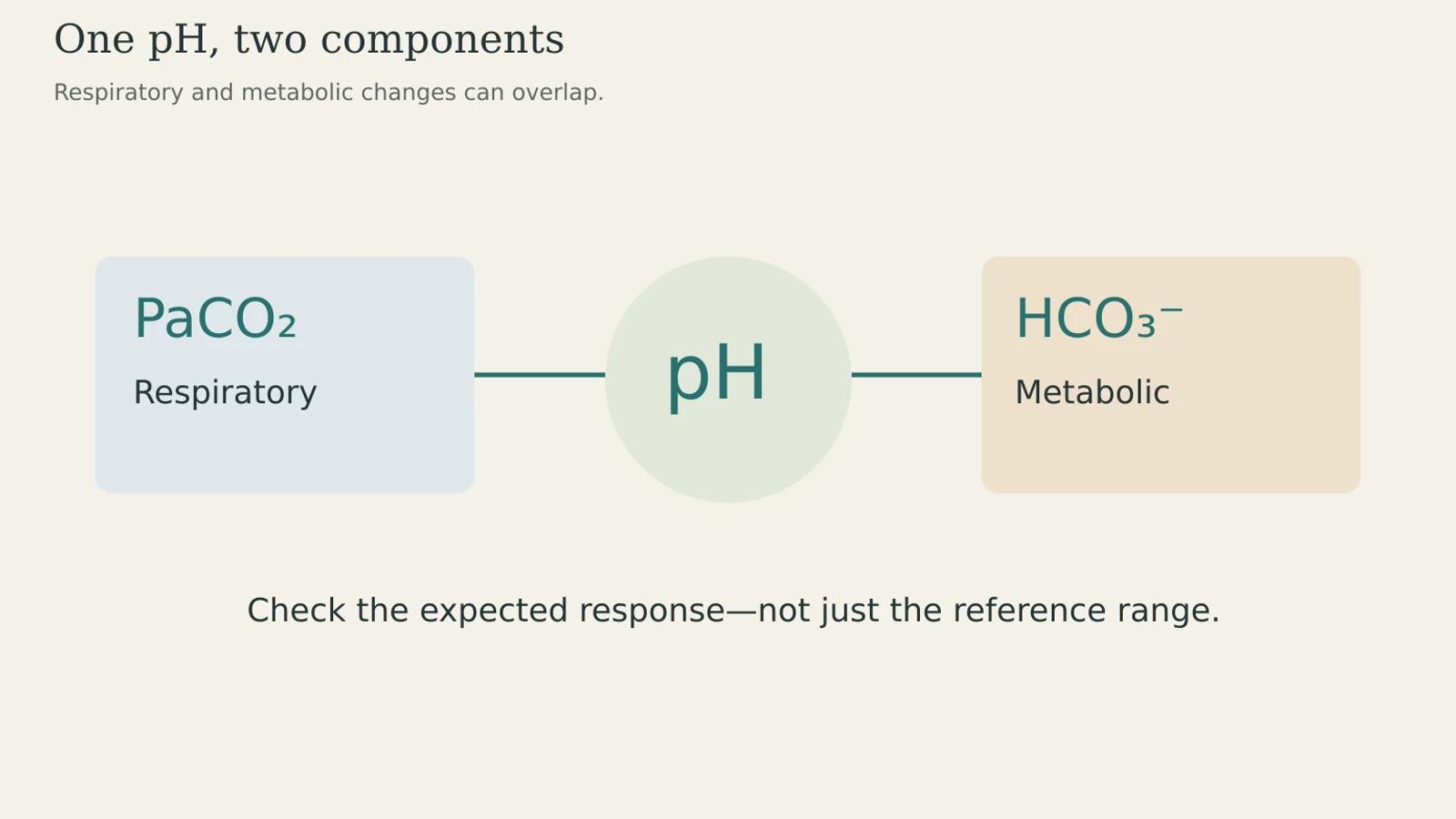
A pH inside the reference interval does not prove an arterial blood gas is normal. A patient can have abnormal carbon dioxide and bicarbonate values that move the pH toward the interval—or two primary disorders that partly conceal each other.
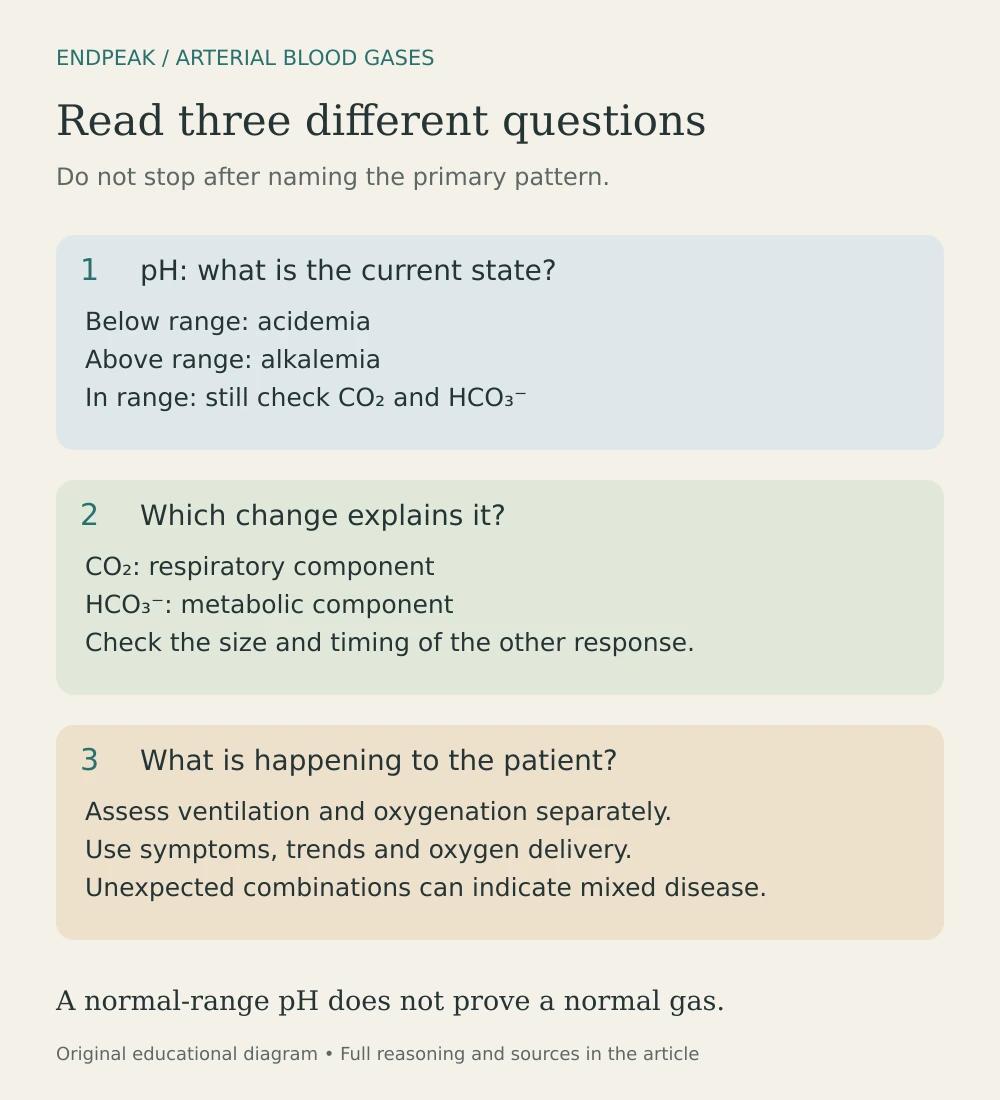
For NCLEX ABG interpretation, separate three questions: What acid–base pattern is present? Does the other value show an expected response? What is happening to ventilation, oxygenation and the patient? That sequence is more dependable than assigning every blood gas a label from a three-box grid.
Read the measurements before naming a disorder
An arterial blood gas measures pH and the partial pressures of carbon dioxide and oxygen. Bicarbonate on a blood-gas report is generally calculated from pH and PaCO₂; it is related to, but not identical to, the chemistry panel's measured total CO₂. Keep the specimen and test names straight when comparing results.
The MedlinePlus ABG reference gives typical arterial values of pH 7.35–7.45, PaCO₂ 35–45 mm Hg, HCO₃⁻ 22–26 mEq/L and PaO₂ 75–100 mm Hg. Reference intervals vary. Interpret oxygenation with age, altitude, inspired oxygen and the clinical situation; a PaO₂ cannot be judged adequately without that context.
NCSBN's current FAQ says items containing numeric laboratory values include the corresponding normal reference ranges. Learn what the measurements mean rather than treating range memorization as the entire task. For other laboratory groups, use ENDPEAK's lab-values interpretation guide; this article develops acid–base reasoning in greater depth.
Use the pH to describe the current state
Acidemia means an arterial pH below 7.35; alkalemia means a pH above 7.45. Acidosis and alkalosis describe processes that push pH down or up. More than one process can be present, which is why a normal-range pH can coexist with important disease.
CO₂ contributes the respiratory acid component: retaining it tends to lower pH, while removing more tends to raise pH. Bicarbonate contributes the metabolic base component: a primary fall tends to lower pH and a primary rise tends to raise it. ROME—respiratory opposite, metabolic equal—helps identify those directional relationships. It does not establish the cause, adequacy of compensation or absence of another disorder.
Four patterns, explained through original cases
These simplified adult teaching cases are original ENDPEAK examples, not official NCLEX items or clinical protocols. Values were checked for acid–base consistency and expected responses; the cases have not received independent professional clinical review. In practice, urgent bedside findings require assessment and escalation under the applicable emergency procedures, rather than waiting to finish a worksheet.
Case 1: high CO₂ and acidemia
An adult has newly slow, shallow breathing and increasing drowsiness after a sedating medication. ABG: pH 7.26, PaCO₂ 60 mm Hg, HCO₃⁻ 26 mEq/L.
The pH shows acidemia. The elevated PaCO₂ pushes in that direction, supporting respiratory acidosis. Bicarbonate has risen only modestly from a conventional baseline near 24 mEq/L, which is compatible with an acute response to this CO₂ rise. Calling it “uncompensated” solely because HCO₃⁻ lies at the edge of a reference interval misses that physiologic response.
The clinical concern is inadequate ventilation with altered alertness. Assess airway and breathing and obtain prompt assistance according to the setting. The gas does not independently prove the medication caused the problem, and a normal oxygen saturation on supplemental oxygen would not exclude CO₂ retention. The MSD respiratory-acidosis reference explains hypoventilation and the difference between acute and chronic responses.
Case 2: low CO₂ does not establish anxiety
An adult has sudden rapid breathing and pleuritic chest discomfort. ABG: pH 7.49, PaCO₂ 30 mm Hg, HCO₃⁻ 22 mEq/L.
This is alkalemia with a low PaCO₂, supporting respiratory alkalosis; the small bicarbonate decrease is compatible with an acute response. The pattern describes increased CO₂ removal. It does not identify why the patient is hyperventilating.
New chest symptoms require assessment for an underlying cardiopulmonary problem; do not infer a panic attack from the gas. The MSD respiratory-alkalosis guidance specifically cautions against attributing hyperventilation to anxiety without evaluating other causes. Paper-bag rebreathing can be dangerous and is not an appropriate reflex response.
Case 3: low bicarbonate, with a purposeful respiratory response
An adult with substantial diarrhea has deep breathing. ABG: pH 7.29, PaCO₂ 30 mm Hg, HCO₃⁻ 14 mEq/L.
The low pH and low bicarbonate support metabolic acidosis. The low PaCO₂ moves pH in the opposite direction: the lungs are removing CO₂, partly offsetting the metabolic process. Gastrointestinal bicarbonate loss is a plausible explanation in this case, but the history and additional studies are needed to evaluate the cause and severity.
For a deeper check, Winter's formula estimates expected PaCO₂ in metabolic acidosis: 1.5 × HCO₃⁻ + 8, with an approximate allowance of ±2 mm Hg. Here, 1.5 × 14 + 8 = 29; the expected interval is about 27–31 mm Hg. The measured 30 fits. This supports an appropriate respiratory response; it does not make the patient well or establish an NCLEX requirement to memorize the formula. See the metabolic-acidosis reference.
Case 4: elevated bicarbonate with alkalemia
An adult has persistent vomiting. ABG: pH 7.49, PaCO₂ 48 mm Hg, HCO₃⁻ 35 mEq/L.
The pH and bicarbonate support metabolic alkalosis. The elevated PaCO₂ tends to lower pH, consistent with respiratory compensation rather than a second alkalinizing change. Gastric acid loss is plausible; evaluate fluid status, electrolytes, ongoing losses and other contributors rather than prescribing treatment from the numbers alone.
The expected response is approximate. An 11-mEq/L rise in bicarbonate above 24 would predict roughly a 6.6–8.25-mm Hg PaCO₂ rise above 40, consistent with this example's 48. These relationships are summarized in MSD's simple-disorder compensation table. They are a consistency check, not exact patient-specific targets.
Two counterexamples to the compensation shortcuts
A pH in range can still accompany an important disturbance
A person with established chronic hypoventilation has pH 7.36, PaCO₂ 60 mm Hg and HCO₃⁻ 33 mEq/L. The high CO₂ and high bicarbonate are not normal merely because the pH is in range. The history and bicarbonate rise support chronic renal compensation for respiratory acidosis. Baseline gases, current symptoms and other results remain important.
Some teaching systems call a normal-range pH with both other values abnormal “fully compensated.” Treat that as a descriptive classroom label, not proof that there is only one disorder or no need for care. Compensation moves pH toward baseline; an opposing change must still be appropriate in size and timing.
Both abnormal values can worsen the same problem
Now consider pH 7.07, PaCO₂ 50 mm Hg, HCO₃⁻ 14 mEq/L. Low bicarbonate and high CO₂ both favor acidemia. With bicarbonate 14, expected compensatory PaCO₂ would be approximately 27–31, not 50. This supports combined metabolic and respiratory acidosis, not “partial compensation.” It is a markedly abnormal pattern requiring urgent clinical evaluation.
Similarly, identifying alkalemia does not rule out an additional metabolic acidosis. Complex evaluation can require electrolytes, anion-gap analysis and other tests beyond an introductory pattern exercise. The MSD overview explains why expected compensation and clinical context must be considered together.
Finish the interpretation with ventilation and oxygenation
The cases above intentionally emphasize acid–base values; they are not complete oxygenation assessments. PaCO₂ helps evaluate ventilation. PaO₂ assesses arterial oxygen tension. A patient may have a ventilation problem, an oxygenation problem or both. Record oxygen delivery when interpreting a real gas, and compare trends and bedside findings.
For practice, write one sentence with three parts: “The primary pattern is __; the other value is __ relative to the expected response; the bedside finding that changes my next step is __.” In Case 1, “respiratory acidosis” is only the first part—the new shallow breathing and drowsiness complete the nursing concern.
ENDPEAK's RN Topics, QBank and AI Tutor can support explanation and practice with applicable account access. When using an AI explanation, compare its compensation claim with the actual numbers and a reliable reference. A confident label is not a substitute for that check.
Sources checked October 2026. The cases use rounded pH values; calculated relationships are approximate, not laboratory calibration standards.
ENDPEAK publishes independent NCLEX-RN study resources. Exam rules are checked against official NCSBN sources. Original teaching examples are identified as such, and clinical review is credited only when it has actually occurred. ENDPEAK is not affiliated with or endorsed by NCSBN.