NCLEX Lab Values: Interpret the Results Before Choosing an Action
Go beyond memorizing ranges: connect electrolytes, CBC, renal tests, glucose, coagulation and ABGs with patient cues and the task the question asks.

Yes—the NCLEX supplies the corresponding normal reference range when an item contains a numeric laboratory value. That is NCSBN's current FAQ guidance. Your preparation still needs physiology, pattern recognition and an understanding of what the nurse should assess or do with the result.
A reference range can tell you that a measurement lies outside it. It cannot tell you whether the patient is deteriorating, whether a treatment target differs from that range or whether the question asks for assessment, communication or an intervention. The worked examples below show those distinctions before the guide revisits the major test groups.
Read the result, the range and the patient together
Start by locating the test name, units, reference range and collection time. A result in mg/dL cannot be compared directly with a value in mmol/L. An earlier result may describe a different stage of the illness. When several results appear in an exhibit, distinguish the current finding from the baseline before choosing an action.
Then ask what else makes the result meaningful: symptoms, vital signs, recent treatment, intake and output, and related tests. A mildly abnormal result in an otherwise unchanged patient is not the same problem as an abrupt change with new respiratory or neurologic findings.
MedlinePlus explains why reference ranges vary. A reference range describes a comparison population and testing method; it is not a universal treatment threshold. A therapeutic target, such as an anticoagulation target, is a separate concept. Critical-result reporting policies also vary between laboratories and institutions.
For a practice question, use the supplied range. For clinical work, use the laboratory's range and reporting policy alongside assessment, orders and protocols. Do not turn an internet “panic values” chart into a standing order.
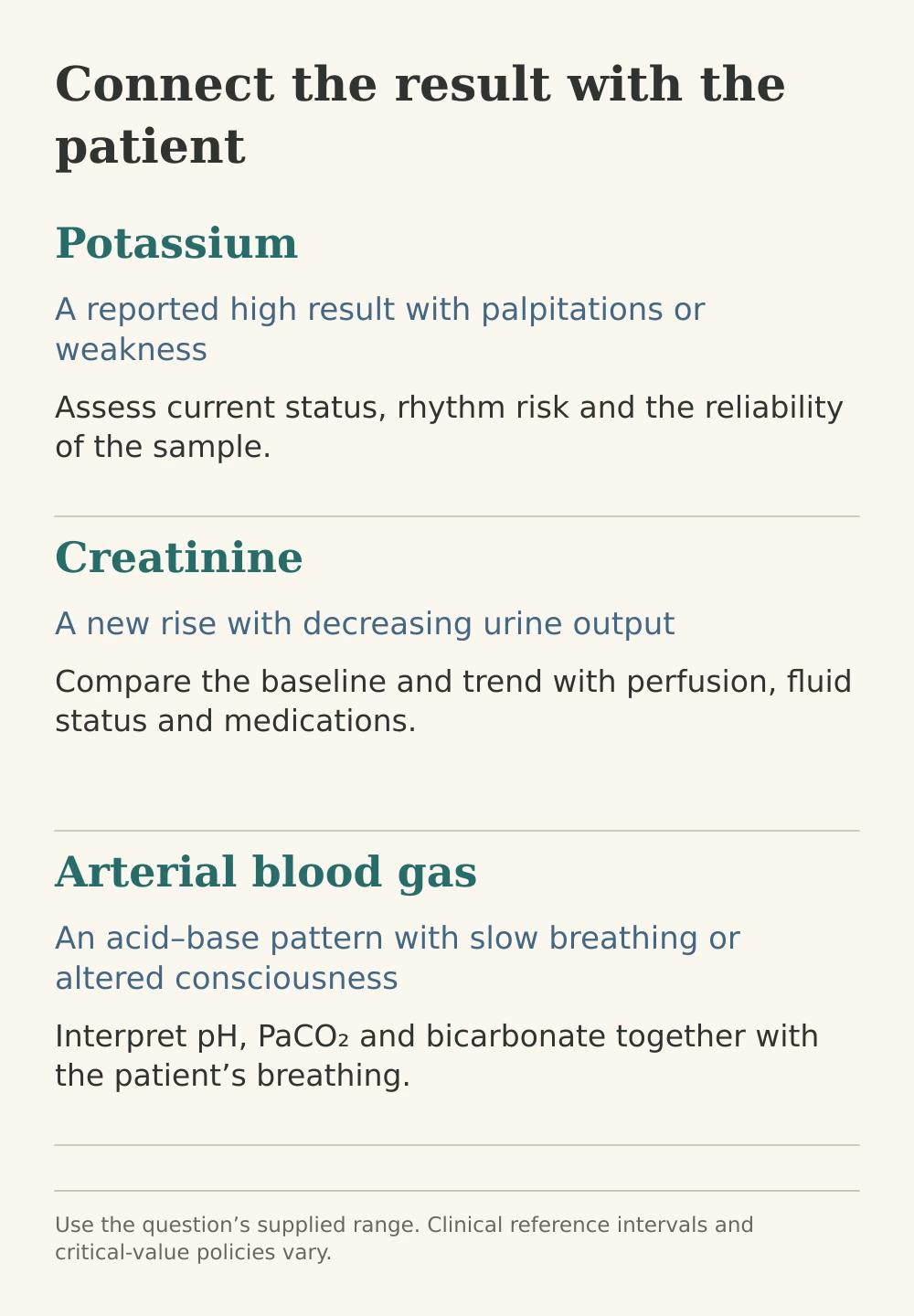
Three original examples: from finding to response
These fictional examples use illustrative adult reference ranges. They are teaching exercises, not official NCLEX items, universal critical thresholds or complete clinical protocols. No independent professional nursing review has been performed.
Potassium: an abnormal result plus a change in condition
An adult with kidney impairment has potassium of 6.1 mmol/L (the exercise's reference range is 3.5–5.0). The patient reports new weakness and palpitations. A scheduled potassium supplement is listed.
The result and symptoms warrant prompt nursing assessment, cardiac evaluation/monitoring and escalation according to the setting's process. Giving the supplement without addressing the findings would ignore an obvious safety conflict. Simply documenting the result for the next shift would also fail to respond to the change.
The reasoning is not “every potassium of 6.1 has the same treatment.” It is “high potassium, impaired clearance, symptoms and a potentially relevant order create an immediate concern.” The treatment team and protocol determine the actual interventions.
Creatinine: the trend matters
A patient's creatinine rises from 0.8 to 1.6 mg/dL over two days (exercise reference range 0.6–1.2), with decreased urine output. Another patient has a documented stable creatinine of 1.6 over several months and no new findings.
The same current number appears in both records. The new rise with reduced output provides stronger evidence of an acute change requiring assessment and follow-up. Review fluid status, medications and related findings; report the trend accurately. Do not label the cause or choose a fluid intervention without the information needed to support it.
ABG: interpret the pattern without losing the bedside picture
An adult becomes unusually drowsy with slow, shallow breathing. ABG results are pH 7.28 (reference 7.35–7.45), PaCO2 58 mm Hg (35–45), and HCO3− 26 mEq/L (22–26).
The low pH and elevated carbon dioxide are consistent with respiratory acidosis. The clinical priority is the respiratory change, requiring prompt airway/breathing assessment and escalation, not completion of an acid–base worksheet. MedlinePlus describes respiratory acidosis as a problem of inadequate carbon dioxide removal. The example does not establish why the patient is hypoventilating or prescribe treatment.
Learn the clinical question behind each group of tests
Electrolytes: connect the imbalance to function
Potassium is important for nerve, muscle and cardiac function. Both high and low levels can be associated with rhythm problems and weakness. Review renal function, losses and medications alongside the value. MedlinePlus's potassium guidance also notes that collection conditions can affect a result. That is a reason to investigate an unexpected measurement, not to dismiss a concerning patient.
Sodium helps regulate fluid balance and supports nerve and muscle function. An abnormal sodium result needs context: the patient's fluid situation, the direction and timing of change, and neurologic symptoms. The sodium test overview explains why different conditions can produce an abnormal value. “Low sodium means give salt” is not a safe interpretation strategy.
When reviewing a question, separate recognition from treatment selection. You may need to assess, obtain monitoring, communicate an urgent finding or implement a prescribed intervention. Replacement or correction strategies cannot be inferred from the number alone.
CBC: identify which cell line matters
A complete blood count includes several different measurements. Hemoglobin relates to oxygen-carrying capacity; platelets contribute to clotting; white blood cells relate to infection and other processes. An elevated total white count is not proof of a particular infection, and a platelet count is not interchangeable with an INR.
Ask whether the scenario concerns oxygen delivery, infection risk or bleeding. Then look for the patient's associated findings. A downward hemoglobin trend with signs of bleeding warrants a different assessment from a stable result being followed over time. Avoid diagnosing the cause of anemia from one number.
Renal results: compare with baseline and output
Creatinine can rise when kidney filtration is impaired, but its interpretation also depends on factors such as muscle mass. MedlinePlus recommends interpreting creatinine with other information, rather than treating it as a complete kidney assessment. Review the trend, estimated filtration information when supplied, urine output and the patient's clinical condition.
In a question about a medication, a changing renal result may prompt review of the order and monitoring requirements. It does not give the nurse permission to invent a dose adjustment. The pharmacology review method helps connect those checks to the individual drug.
Glucose: distinguish a current problem from a long-term measure
A current blood glucose result describes a different timescale from a long-term glycemic marker. Relate the current value to symptoms, food intake and glucose-lowering treatment. For a patient with a low value and symptoms, safety and timely treatment under the applicable protocol matter more than explaining the entire history of diabetes.
The NIDDK hypoglycemia guidance describes prompt carbohydrate treatment and repeat glucose checking for someone who can treat a low safely. A patient who cannot swallow safely needs a different emergency approach. An intervention's route is part of the decision, not a detail to add afterward.
Coagulation: name the test and the treatment
PT/INR is used for several clotting assessments and commonly to monitor warfarin. A prescribed therapeutic INR target is not the same as the reference range for someone not receiving anticoagulation. PTT testing evaluates a different part of clotting and may be used when monitoring heparin.
Do not assume that every anticoagulant uses INR, or that one value tells you whether a patient is bleeding. Check the actual drug, indication, target, symptoms and current orders. If a question asks which finding needs follow-up before administration, identify the specific safety concern rather than reflexively selecting any abnormal test.
ABGs: keep ventilation, oxygenation and pH separate
An arterial blood gas can provide information about acidity, carbon dioxide and oxygen. PaCO2 helps evaluate carbon dioxide removal; PaO2 addresses oxygen in arterial blood. Bicarbonate contributes to acid–base interpretation. These are related measurements, not synonyms.
For an initial interpretation, determine whether pH is low or high, then ask whether the carbon dioxide and bicarbonate findings help explain it. Check oxygenation separately and return to the respiratory assessment. A mnemonic may help organize a simple pattern, but it cannot establish the cause or exclude a mixed disorder.
Source note: Exam expectations were checked against the NCSBN FAQ and 2026–2029 RN Test Plan in October 2026. Clinical explanations link to NIH MedlinePlus and NIDDK. The teaching ranges, cases and interpretation prompts are original educational material; local ranges, orders and protocols govern clinical practice.
A completed interpretation note
For the creatinine example, a useful note reads: “Creatinine rose from 0.8 to 1.6 mg/dL over two days, with reduced urine output. The change from baseline matters more than the current number alone. I need to assess the patient's fluid and clinical status, review related information and communicate the trend.” This note explains the concern without inventing its cause or a treatment order.
Now write the equivalent note for the ABG example: test pattern, bedside finding and the nursing responsibility the question asks about. If you can identify respiratory acidosis but omit the slow, shallow breathing, your interpretation has lost the most important patient cue. Use the patient-priority comparisons when several findings compete for attention.
ENDPEAK publishes independent NCLEX-RN study resources. Exam rules are checked against official NCSBN sources. Original teaching examples are identified as such, and clinical review is credited only when it has actually occurred. ENDPEAK is not affiliated with or endorsed by NCSBN.