NCLEX Dosage Calculations: Seven Worked Problems and Safety Checks
Work through original NCLEX dosage calculations with unit cancellation, weight-based dosing, IV rates, rounding and a reverse check for every answer.
A dosage calculation is complete only when the answer has the right number, the right unit and a reasonable relationship to the information supplied. A calculator can multiply correctly while you solve the wrong problem—for example, treating a daily dose as a dose to give every eight hours.
This NCLEX dosage calculations guide builds one method across seven original exercises. Start by naming the unit you need. Arrange the data so unwanted units cancel, calculate without premature rounding, and then check the answer against the order and available product.
These are educational arithmetic exercises, not prescriptions or medication-administration instructions. Unnamed medications and supplied dose ranges are deliberately fictional; they do not establish safe dosing for any real drug. The problems have been checked programmatically, but have not received independent professional nursing review.
What the NCLEX provides—and what you still need to decide
The official NCLEX exam-day guidance confirms an on-screen calculator and an erasable note board and marker. The NCLEX FAQs say calculation items specify a whole-number answer or one to two decimal places, require a decimal point when decimals are requested, and should be rounded at the end. Follow the individual item's directions; do not substitute a school's universal rounding rule.
The calculator does not decide whether the question asks for mg, mL, tablets, mL/hour or drops/minute. Write that target before entering numbers. In clinical care, the precision you can measure also depends on the actual delivery device, product and applicable policy. An exam's requested decimal place is not permission to measure an impractically small volume.
Build the calculation around units
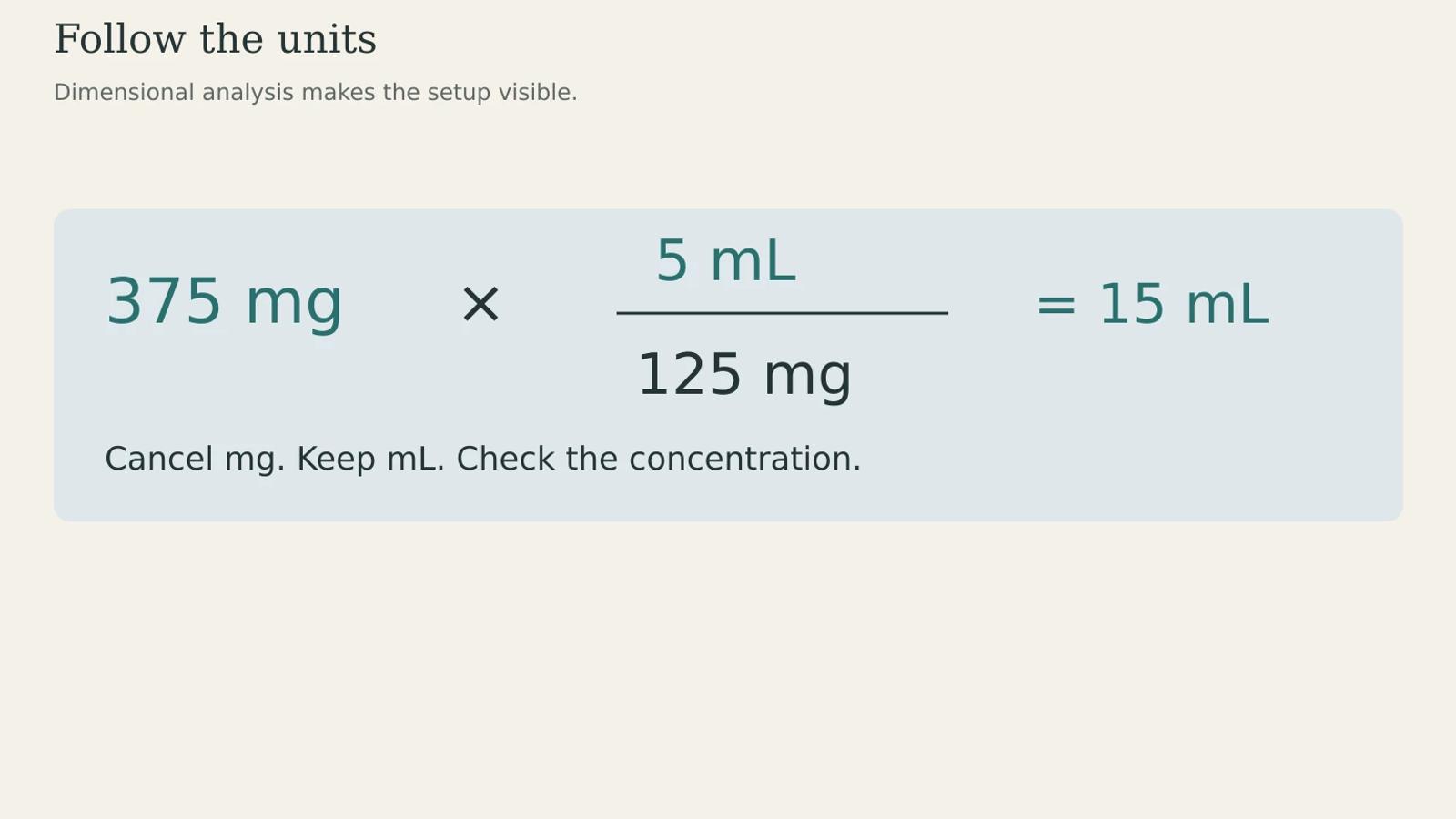
Dimensional analysis treats each conversion or concentration as a fraction. Choose its direction so the unit you no longer need appears once above and once below the multiplication line. If the remaining unit is not your target, the setup is unfinished even if the number looks familiar.
The basic metric relationships used here are 1 g = 1,000 mg, 1 mg = 1,000 mcg and 1 L = 1,000 mL. For the weight exercise, use the explicitly supplied approximation 1 kg = 2.2 lb. Keep that conversion separate from the prescribed dose.
For a simple product calculation, Desired ÷ Have × Quantity is the same relationship in a shorter form. “Have” means the dose contained in the stated quantity—not the total package volume. Convert desired and available dose into matching units before dividing. WisTech Open's oral-medication chapter develops this unit-matching approach.
Problems 1–3: from tablets to a unit conversion
1. Whole tablets: establish the direction
The exercise specifies an oral dose of 300 mg. The available immediate-release product contains 150 mg per tablet. How many tablets correspond to the stated dose?
Setup: 300 mg × (1 tablet ÷ 150 mg) = 2 tablets. Equivalently, (300 ÷ 150) × 1 = 2.
Check: two 150-mg tablets contain 300 mg. Reversing the fraction would leave mg squared per tablet instead of tablets. This problem does not authorize splitting, crushing or substituting another formulation; those are separate medication-safety decisions.
2. Liquid concentration: the quantity belongs to the label
An exercise calls for 180 mg of an unnamed oral medication. The liquid contains 120 mg in 5 mL. Find the volume.
Setup: 180 mg × (5 mL ÷ 120 mg) = 7.5 mL.
Check: 180 mg is one and a half times 120 mg, so the volume should be one and a half times 5 mL. Calculating 180 ÷ 120 and stopping at 1.5 misses the quantity: 1.5 is the number of 5-mL portions, not the final volume.
3. Different units: convert before comparing
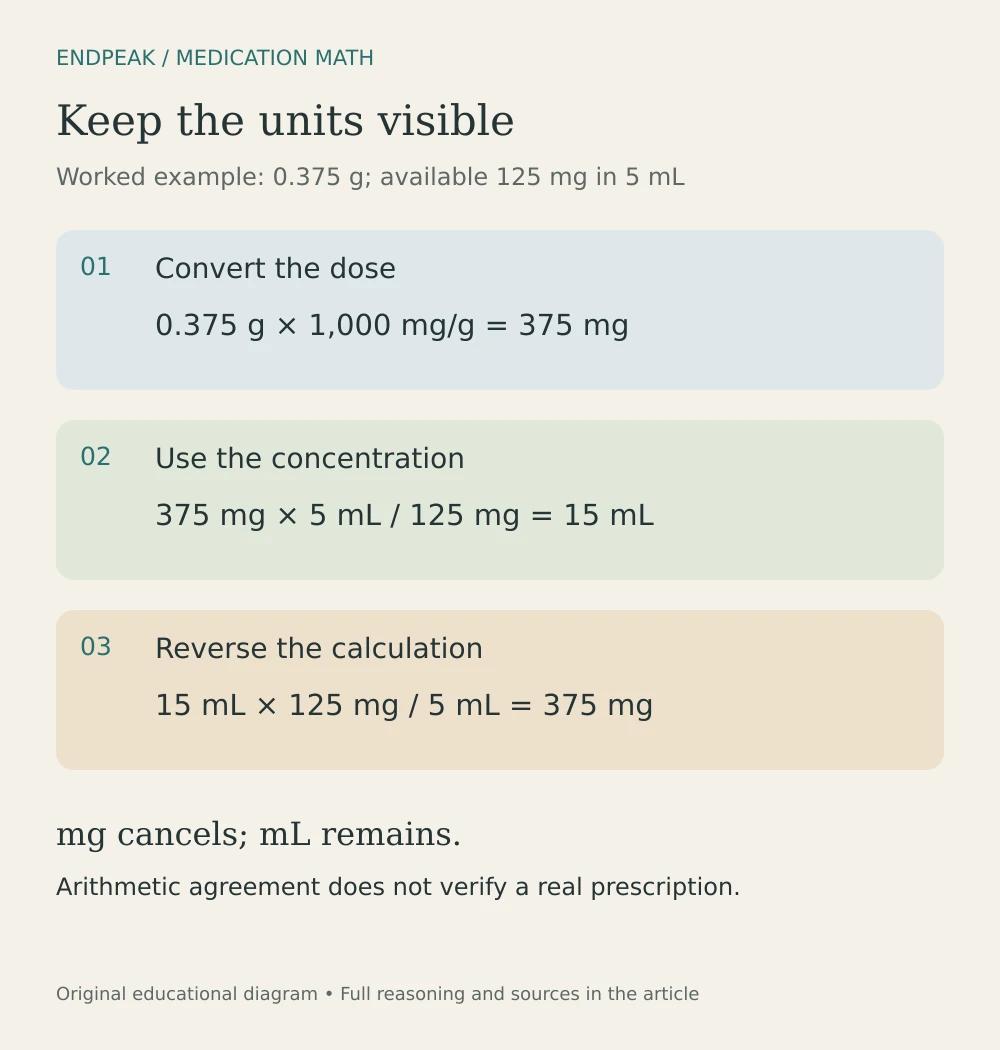
The stated dose is 0.375 g. The available liquid contains 125 mg in 5 mL. Calculate the corresponding volume.
Setup: 0.375 g × (1,000 mg ÷ 1 g) × (5 mL ÷ 125 mg) = 15 mL.
Check: 0.375 g is 375 mg. Three portions of 125 mg provide 375 mg, and three portions of 5 mL total 15 mL. Skipping the g-to-mg step creates a thousandfold error. A leading zero makes 0.375 easier to read; avoid a trailing zero that can obscure a decimal point in medication documentation.
Problem 4: a daily weight-based amount is not a single dose
A fictional exercise gives a child's weight as 44 lb and supplies 1 kg = 2.2 lb. The stated regimen is 24 mg/kg/day, divided into three equal doses. The exercise liquid contains 80 mg in 5 mL. Find mL per dose. No real medication is implied.
Weight: 44 lb × (1 kg ÷ 2.2 lb) = 20 kg.
Daily amount: 20 kg × 24 mg/kg/day = 480 mg/day. Divide that daily amount into three equal doses: 480 ÷ 3 = 160 mg/dose.
Volume: 160 mg/dose × (5 mL ÷ 80 mg) = 10 mL/dose.
Reverse check: 10 mL contains 160 mg. Three doses total 480 mg/day. Dividing by 20 kg returns 24 mg/kg/day. If you obtained 30 mL per dose, you calculated the entire daily volume and failed to divide it.
Now change only the wording to 24 mg/kg/dose. That would be a different order, not an alternative way to describe this one. WisTech Open's weight-based chapter is useful for reviewing why the time basis matters.
Problems 5–6: keep infusion volume, time and drop factor separate
5. Pump rate in mL/hour
An arithmetic exercise specifies 750 mL of IV solution over six hours. What rate in mL/hour corresponds to those data?
Setup: 750 mL ÷ 6 hours = 125 mL/hour. Check by multiplying: 125 mL/hour × 6 hours = 750 mL. This verifies the arithmetic, not the suitability of that fluid volume for a particular patient.
If the time is given in minutes, convert it: 100 mL over 45 minutes is 100 mL × (60 minutes/hour) ÷ 45 minutes = 133.333… mL/hour. If this exercise requests one decimal place, record 133.3 mL/hour. Keep the unrounded value until the final step.
6. Gravity rate in drops/minute
The exercise specifies 500 mL over four hours with tubing labeled 15 drops/mL. Calculate whole drops/minute.
Setup: (500 mL × 15 drops/mL) ÷ (4 hours × 60 minutes/hour) = 31.25 drops/minute. Rounded as requested, the answer is 31 drops/minute.
The drop factor comes from the specified tubing; do not assume it from the bag. Pump settings in mL/hour and gravity rates in drops/minute are different outputs. The WisTech infusion chapter explains these relationships. Its course rounding directions are not a replacement for the NCLEX item's directions or clinical device requirements.
Problem 7: correct arithmetic can expose an unsafe proposal
A fictional 18-kg patient has an exercise order for 150 mg per dose. The problem explicitly supplies an acceptable range of 5–7 mg/kg/dose. Is the stated dose inside that supplied range?
Lower boundary: 18 × 5 = 90 mg/dose. Upper boundary: 18 × 7 = 126 mg/dose. The proposed 150 mg is above the exercise's upper boundary.
The useful answer is to recognize the discrepancy and seek clarification through the appropriate clinical process, rather than silently substitute 126 mg or calculate an administration volume as though the discrepancy were resolved. For a real medication, verify the indication, route, interval, patient factors and authoritative product-specific dosing information. A supplied arithmetic range cannot establish those facts.
A final check that catches more than a calculator can
Before submitting, ask: Did I answer the requested unit? Did I use the correct concentration? Did I distinguish per day from per dose? Did I convert all time and weight units? Does a reverse calculation recover the stated dose or volume? Did I round only at the end?
If the number is unexpectedly large or small, stop and inspect the setup. Do not move the decimal simply to make the result look comfortable. An unusual result can reflect an arithmetic error, a misread label, incomplete information or an order that needs clarification.
For the medication knowledge surrounding the arithmetic, use the pharmacology review guide. ENDPEAK's RN Topics and QBank can support review alongside a study plan; account access and applicable enrollment are required. After a practice problem, preserve the unit setup in your notes. The next useful exercise is the same relationship with a different unit or time basis—not another attempt at a memorized number.
Exam rules and educational references checked October 2026. The seven exercises and their numerical data are original ENDPEAK teaching material. No official NCLEX question or drug-specific treatment protocol is reproduced.
ENDPEAK publishes independent NCLEX-RN study resources. Exam rules are checked against official NCSBN sources. Original teaching examples are identified as such, and clinical review is credited only when it has actually occurred. ENDPEAK is not affiliated with or endorsed by NCSBN.