NCLEX Pharmacology Review: Study Drug Classes Through Nursing Decisions
Build compact medication cards that connect purpose, action, assessment, harm, teaching and evaluation, then compare families through nursing decisions.

You recognize the medication name, remember several adverse effects and still choose the wrong nursing action. That usually means the facts are stored as a list rather than connected to the patient's situation.
A useful NCLEX pharmacology review builds those connections: what the medication changes, which observations matter before administration, what harm needs attention and how you evaluate the response. Drug families make the workload manageable; the individual drug and patient keep the reasoning accurate.
Set the boundary of your review
The 2026–2029 NCLEX-RN test plan assigns 13–19% to Pharmacological and Parenteral Therapies. That category includes more than remembering drug names. Use the official plan to check medication safety, administration, calculations and parenteral care as well as pharmacology.
NCSBN does not publish a list of medications guaranteed to appear. A commercial “must-know” list can organize study, but it is not an official exam inventory. The NCLEX FAQ says generic medication names are used on most occasions, so make them the starting point for your cards.
This guide demonstrates a study method with selected examples. It is not a complete medication reference or prescribing guide. The clinical facts were checked against the linked references, but this article has not received independent professional nursing review. Clinical decisions require current medication references, patient-specific orders and facility policies.
Build a medication card around decisions
Choose one representative medication from a family. On one side of a card, write the generic name and a brief patient context. On the other, connect six elements:
- Purpose: what problem is the medication intended to address?
- Action: what change in the body explains its effect?
- Before: which assessment, allergy, lab result, interaction or contraindication could change the administration decision?
- Harm: which adverse effects require prompt attention, and which findings need routine follow-up?
- Teaching: what should the patient know or report?
- After: what would show benefit or harm?
Keep the mechanism short enough to use. A copied paragraph about receptors is not helping if you cannot explain why the patient's current finding matters. Add a separate note for important exceptions rather than pretending every drug in the family behaves identically.
Compare families that can be confused
ACE inhibitors: blood pressure is only one check
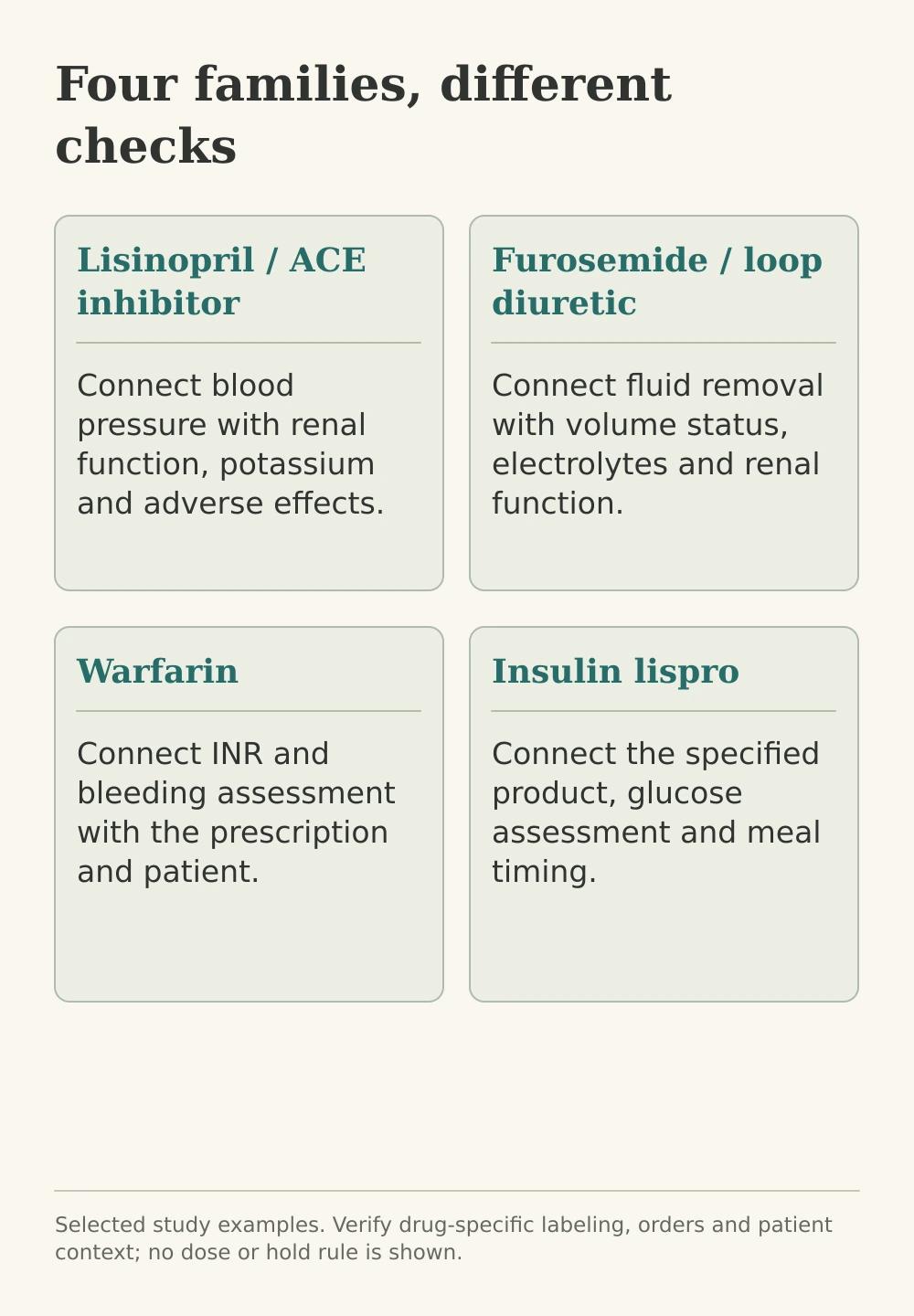
Lisinopril reduces angiotensin-converting enzyme activity. Alongside blood pressure and response, its labeling calls for attention to renal function and serum potassium. Important risks include hyperkalemia and angioedema; pregnancy is a major safety concern. DailyMed prescribing information explains these warnings.
Turn that into a study prompt: “A patient taking lisinopril develops tongue swelling. Why does this finding require more urgent attention than an unchanged dry cough?” The task is to recognize the airway threat, not merely recite two listed effects. Our prioritization guide explores that contrast.
Loop diuretics: connect fluid removal with what can be lost
Furosemide promotes renal salt and water excretion. Its labeling warns about fluid depletion and electrolyte disturbances, including hypokalemia. Study fluid status, blood pressure, renal function and electrolytes in the context of the prescription and patient.
Compare this card with lisinopril: both may appear in a cardiovascular scenario, but their potassium concerns are not the same. Do not learn “heart medication → potassium” without learning the direction of the risk. Also do not extend the loop-diuretic pattern to every diuretic; different families need separate cards.
To reason through the laboratory findings used in these medication decisions, compare results, trends and patient cues in our NCLEX lab-values guide.
Warfarin: distinguish monitoring from generic “blood thinner” knowledge
Warfarin reduces blood clotting and can cause serious bleeding. Its response is monitored with PT reported as INR. The MedlinePlus drug reference also emphasizes medication interactions and consistent vitamin K intake.
A useful teaching prompt is “Should this patient eliminate all foods containing vitamin K?” The safer learning point is consistency and discussion of dietary changes with the care team, not a blanket food ban. Keep warfarin's INR monitoring on its own card; do not assume every anticoagulant uses the same routine monitoring method.
Rapid-acting mealtime insulin: the product and meal matter
Insulin lispro helps move glucose from the blood into tissues. Study the exact product, glucose assessment, meal timing and hypoglycemia risk together. The MedlinePlus lispro reference distinguishes formulations and their administration instructions. Do not apply one remembered timing rule to every insulin product.
Original study prompt: “A scheduled mealtime dose is approaching, but the meal has been delayed. What information and orders need clarification before administration?” Explain the relationship between insulin action and food availability. This exercise does not supply a dose, tell you to independently change an order or replace a facility protocol.
Use names as clues, then verify the medication
Suffixes can help you recognize a family, but a name pattern is a starting clue rather than a complete safety assessment. Confirm the generic drug, formulation, route and current reference. A correct family guess does not reveal every contraindication, interaction or administration requirement.
For internationally educated nurses, compare unfamiliar U.S. generic names and formulations with the references used in your previous setting. Avoid assuming that a familiar brand has the same formulation or labeling everywhere.
Turn rereading into retrieval and application
Close the reference and explain the card aloud. Then use a new question to test whether you can retrieve the knowledge when it is embedded in a patient chart. If the answer is wrong, identify the missing link: did you not recognize the drug, overlook a current finding or choose an action before checking essential information?
On a later review, mix families that require different monitoring. Ask yourself why INR belongs on the warfarin card and why potassium deserves different attention for lisinopril and furosemide. Comparing closely related decisions can expose a misconception that rereading one card would leave intact.
Use a manageable cycle: learn one family, retrieve the safety connections, apply them in unfamiliar items and revisit the errors. Place the cycle in the adaptable study plan. The interval and workload should fit what you can review properly; this is not an official medication-study quota.
Do not let a short comparison become your whole curriculum
The four examples demonstrate the method, not all NCLEX medication content. Build additional cards across the blueprint, including anti-infectives, analgesics, psychiatric medications and other endocrine therapies. Keep calculations, administration routes, IV care and parenteral safety visible in the coverage plan.
Use the RN test-plan overview for that broader check. When a topic stays weak, use current drug references to repair the precise gap; do not substitute a longer list of names for understanding.
Likewise, a high score on repeated medication questions may reflect recall of those items. Use the QBank readiness checklist to evaluate fresh practice, coverage and recurring errors.
ENDPEAK's RN Topics and QBank can support the learn–retrieve–apply cycle. Access to the study tools requires an account and applicable permissions. Keep a current medication reference available when reviewing; no preparation platform replaces patient-specific clinical judgment.
Sources and review limits
Checked October 2026: 2026 RN test plan; NCLEX FAQs; NCSBN medication-list FAQ; DailyMed labeling for lisinopril and furosemide; MedlinePlus references for warfarin and insulin lispro. The cards and review cycle are ENDPEAK's educational framework. No dose, universal hold threshold or clinical treatment protocol is provided.
ENDPEAK publishes independent NCLEX-RN study resources. Exam rules are checked against official NCSBN sources. Original teaching examples are identified as such, and clinical review is credited only when it has actually occurred. ENDPEAK is not affiliated with or endorsed by NCSBN.