NCLEX Isolation Precautions: Choose the Complete Barrier Plan
Compare Standard, Contact, Droplet and Airborne Precautions with current CDC guidance, organism-specific checks and three original safety scenarios.
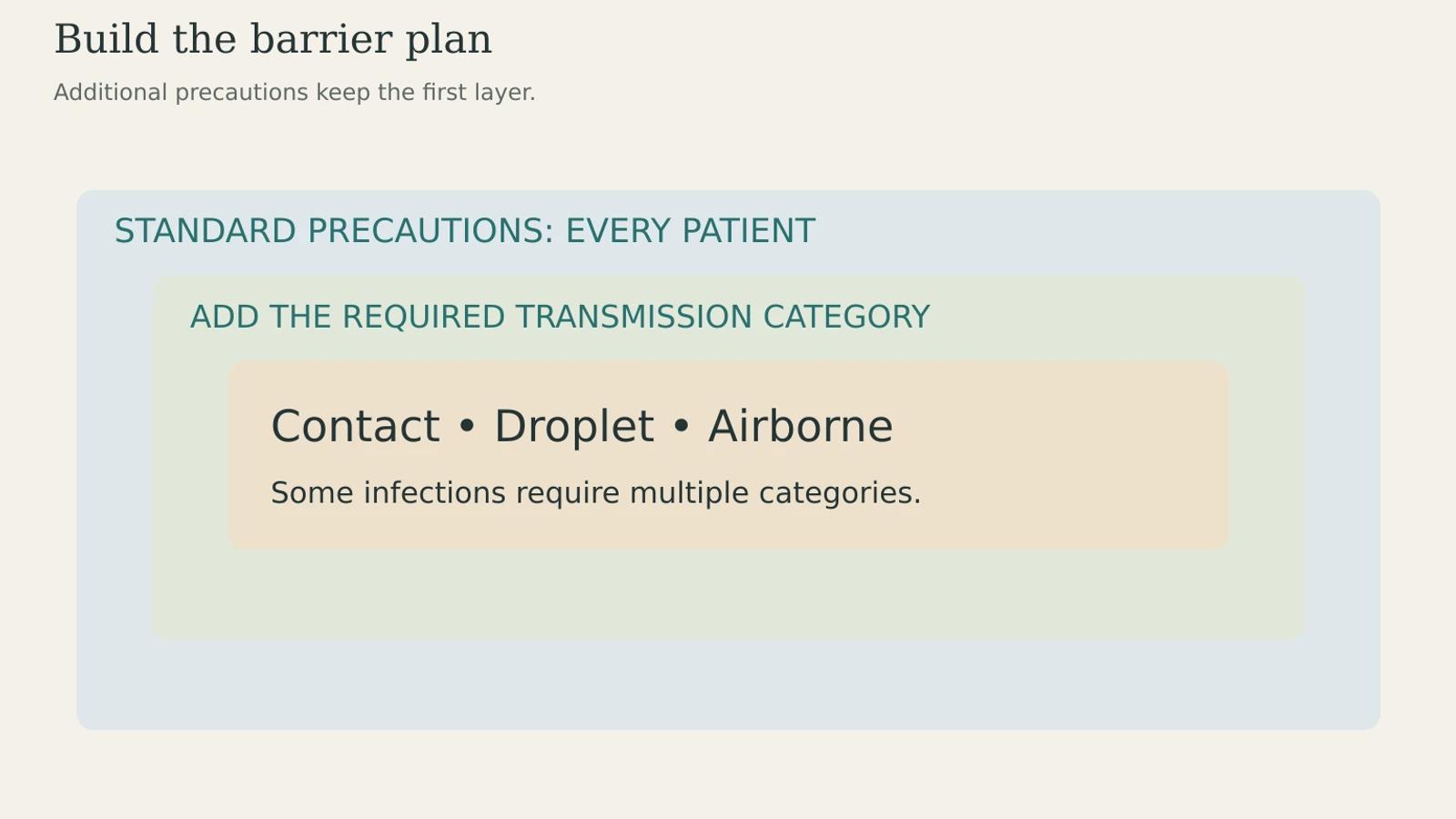
Contact, Droplet and Airborne Precautions are additions to Standard Precautions. Choosing one does not remove the need for hand hygiene, exposure-based PPE, safe injections or equipment cleaning. Some infections require more than one additional category.
For NCLEX isolation precautions, answer a practical question: what could carry this organism from this patient to someone else, and which barriers does the situation require? A disease mnemonic can suggest a category, but the organism, symptoms, care setting and specific exposure determine whether the full plan is adequate.
The first layer applies to every patient
CDC Standard Precautions apply to all patient care. PPE depends on anticipated exposure: gloves when contact with potentially infectious material is expected, and protection for clothing, eyes and face when the task creates those exposure risks. Standard Precautions do not mean “no PPE.”
They also include respiratory hygiene, safe handling of equipment and sharps, environmental cleaning and appropriate patient placement. A patient without a known infection still needs this layer. Conversely, knowing a patient's diagnosis does not remove the need to assess the task: routine conversation and a procedure likely to splash secretions do not create identical exposures.
In the NCLEX-RN test-plan framework, these decisions belong within safe care. This guide concentrates on transmission prevention, rather than which patient to assess first or which team member may perform a task.
Compare the additional barriers
Contact: protect against patient and environmental contact
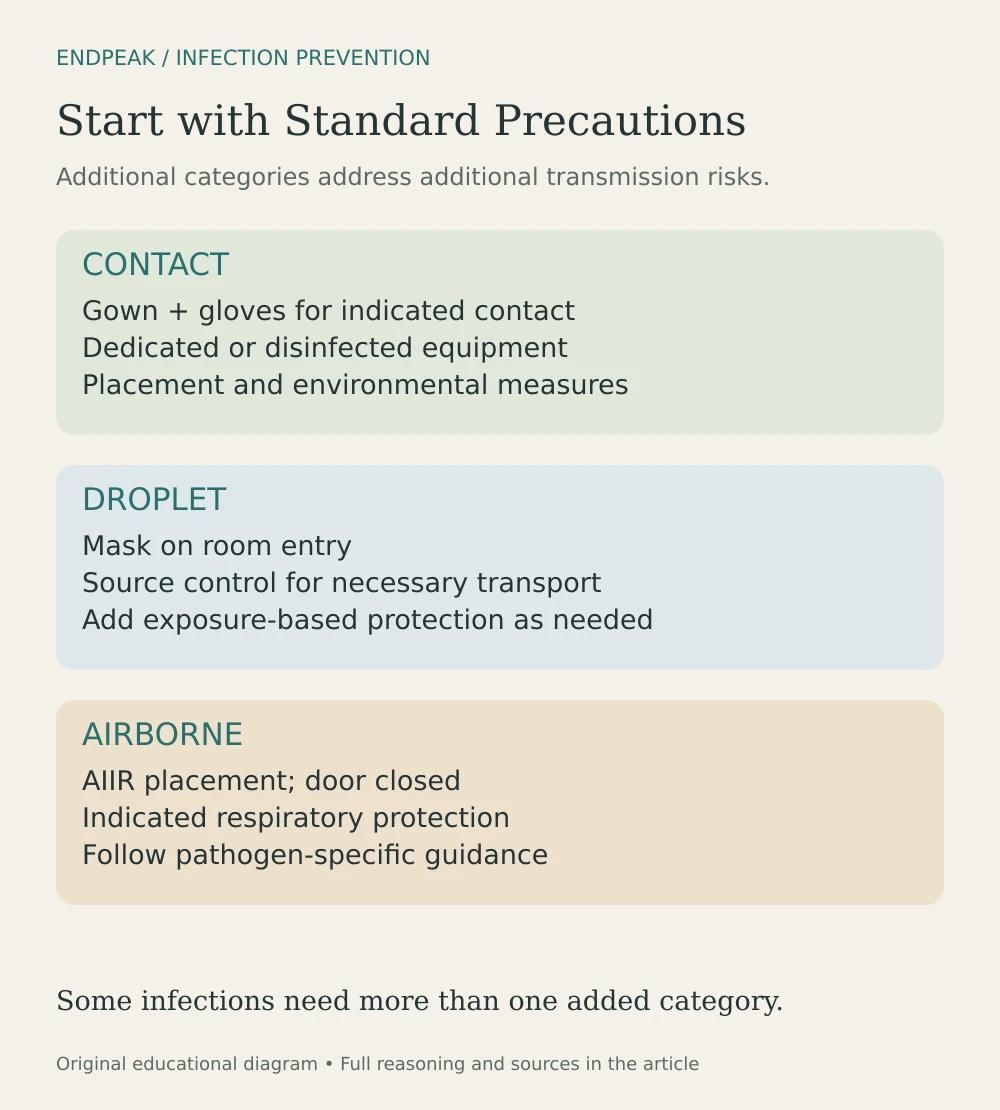
Think about contaminated hands, clothing and equipment carrying material between surfaces or patients. Under CDC's transmission-based guidance, gown and gloves are used for interactions that may involve the patient or their environment, with PPE put on at entry and appropriately removed before leaving. Dedicate equipment or clean and disinfect it before another patient uses it.
A single room is preferred when available in acute care. Patient placement in residential and ambulatory settings requires the appropriate setting-specific assessment. A shared blood-pressure cuff is part of the transmission question, not an irrelevant detail after the PPE choice.
Droplet: protect mucous membranes and control the source
For the Droplet category, wear a mask on room entry and use appropriate placement; a single room is preferred when possible. Put a mask on the patient for necessary transport if tolerated. Special airborne ventilation is not routinely required for this category. Standard Precautions can still add eye protection, gown or gloves according to the exposure, and pathogen-specific guidance can add requirements.
A surgical mask for the patient and a mask for the healthcare worker serve related but different purposes: source control reduces what the patient releases, while the worker's barrier helps protect the worker. One does not automatically replace the other.
Airborne: the room is part of the protection
For infections requiring Airborne Precautions, arrange an airborne infection isolation room (AIIR), with the door closed except for entry and exit. The CDC isolation recommendations describe negative-pressure placement and organism-specific respiratory protection. A routine private room and an AIIR are not interchangeable.
For suspected pulmonary tuberculosis, respiratory protection includes a fit-tested N95 or higher-level respirator under the respiratory-protection program. For measles, CDC's measles guidance requires at least fit-tested N95-level protection for personnel entering the care area, regardless of presumptive immunity. A surgical mask is not a substitute for the indicated respirator.
A compact organism check—with the exceptions attached
The following associations were checked against CDC Appendix A. That page incorporates updates to the longstanding isolation guideline; check its current disease entry and any linked pathogen-specific guidance instead of relying on the guideline's original publication year alone.
- C. difficile infection: Contact plus Standard Precautions. Include equipment and environmental measures; gloves alone do not complete the plan.
- Known or suspected meningococcal disease: Droplet plus Standard Precautions, continuing until 24 hours after effective therapy begins under CDC's listed guidance. “Meningitis” without an organism is too broad to assign every case the same category.
- Suspected or confirmed infectious pulmonary tuberculosis: Airborne plus Standard Precautions. Latent tuberculosis infection is a different situation; do not transfer this category to everyone with a positive screening test.
- Measles: Airborne plus Standard Precautions, with the additional measles-specific protection and staffing considerations.
- Varicella: Airborne plus Contact plus Standard Precautions. An “airborne disease” label alone leaves out a required layer.
Precaution duration is disease-specific and can depend on immune status, symptoms, treatment or clearance criteria. Do not generalize the meningococcal 24-hour rule to tuberculosis, measles or every respiratory infection. Suspected disease may require empiric precautions before confirmation; follow current assessment and infection-prevention procedures rather than waiting for a final culture.
Three original scenarios: name the missing protection
These are original ENDPEAK teaching exercises, not official NCLEX items. They use the linked CDC guidance and have not received independent professional nursing review. Actual placement and PPE decisions follow current local infection-prevention procedures and pathogen-specific recommendations.
1. The gown is correct; the equipment plan is incomplete
A hospitalized patient has C. difficile diarrhea. The nurse plans gown and gloves for care, then intends to use the same uncleaned commode and reusable equipment for another patient. Is the plan complete?
No. Contact plus Standard Precautions must include safe handling and cleaning of equipment and the environment. The correct PPE does not prevent transmission from an item moved between patients without appropriate decontamination. Arrange dedicated equipment or the required cleaning process, and follow the facility's C. difficile environmental protocol.
Hand hygiene requires nuance. Alcohol does not reliably inactivate C. difficile spores, but CDC does not simply prohibit alcohol-based hand rub for all routine care of every patient with C. difficile. Its healthcare-worker hand-hygiene guidance emphasizes gloves, hand hygiene and soap-and-water washing when hands are visibly soiled; during C. difficile outbreaks, wash with soap and water after care. Follow the facility's applicable instructions. Gloves never replace hand hygiene.
2. A suspected diagnosis does not require waiting unprotected
An adult is being evaluated for meningococcal meningitis. A proposed plan delays Droplet Precautions until the organism is confirmed. Is that the safer interpretation?
No. The CDC entry includes known or suspected meningococcal disease. Use Droplet plus Standard Precautions while the evaluation proceeds under the appropriate orders and policy. If the patient's diagnosis changes, reassess the precautions against the identified cause. The reasoning is specific to the suspected organism, not a rule that every meningitis diagnosis has identical requirements.
3. One transmission route does not cancel another
A patient with varicella is placed in an AIIR. A learner says, “The room handles airborne spread, so Contact Precautions are unnecessary.” What is missing?
The patient's placement addresses only part of the required plan. Varicella requires Airborne and Contact Precautions in addition to Standard Precautions. Staff assignment and exposure management also involve immunity and occupational-health guidance. Do not simplify this to an all-purpose mask rule or assume an immune worker can ignore all precautions.
When the patient needs to leave the room
Limit movement to medically necessary purposes and communicate the precautions to the receiving team. Use the pathogen-specific transport measures: contain infectious material, use source control when indicated and avoid carrying contaminated PPE into clean areas. The receiving area needs the appropriate equipment and placement plan before arrival.
For study, annotate each practice option with its function: patient placement, worker protection, source control, hand hygiene or equipment/environment. An answer that supplies only one function may leave another stated exposure unaddressed. ENDPEAK's RN Topics, QBank and Practice Exam offer places to apply that comparison with applicable account access.
Finish by revisiting the varicella case: name the protection against contact, the protection against airborne spread and the precautions that apply to every patient. If your explanation contains only a disease name and a mask, it has not yet described the full barrier plan.
CDC sources checked October 2026. This is an educational guide to acute-care reasoning, not a replacement for facility policy, occupational-health assessment or updated pathogen-specific guidance.
ENDPEAK publishes independent NCLEX-RN study resources. Exam rules are checked against official NCSBN sources. Original teaching examples are identified as such, and clinical review is credited only when it has actually occurred. ENDPEAK is not affiliated with or endorsed by NCSBN.