NCLEX-RN Test Plan 2026–2029: What to Study and How to Prepare
Use the current NCSBN blueprint to balance content coverage, clinical judgment and targeted review—without treating exam percentages as a rigid study calendar.

A study schedule organized only by body system can leave an important gap: the NCLEX-RN also asks what a nurse should do with that knowledge. Knowing the signs of heart failure is one task. Deciding which change needs immediate follow-up, which medication finding to report and whether an intervention worked are different tasks.
The 2026 NCLEX-RN Test Plan is the official blueprint for examinations from April 1, 2026, through March 31, 2029. It describes entry-level RN practice and organizes content by Client Needs. Use it to check both what you study and the decisions you practice.
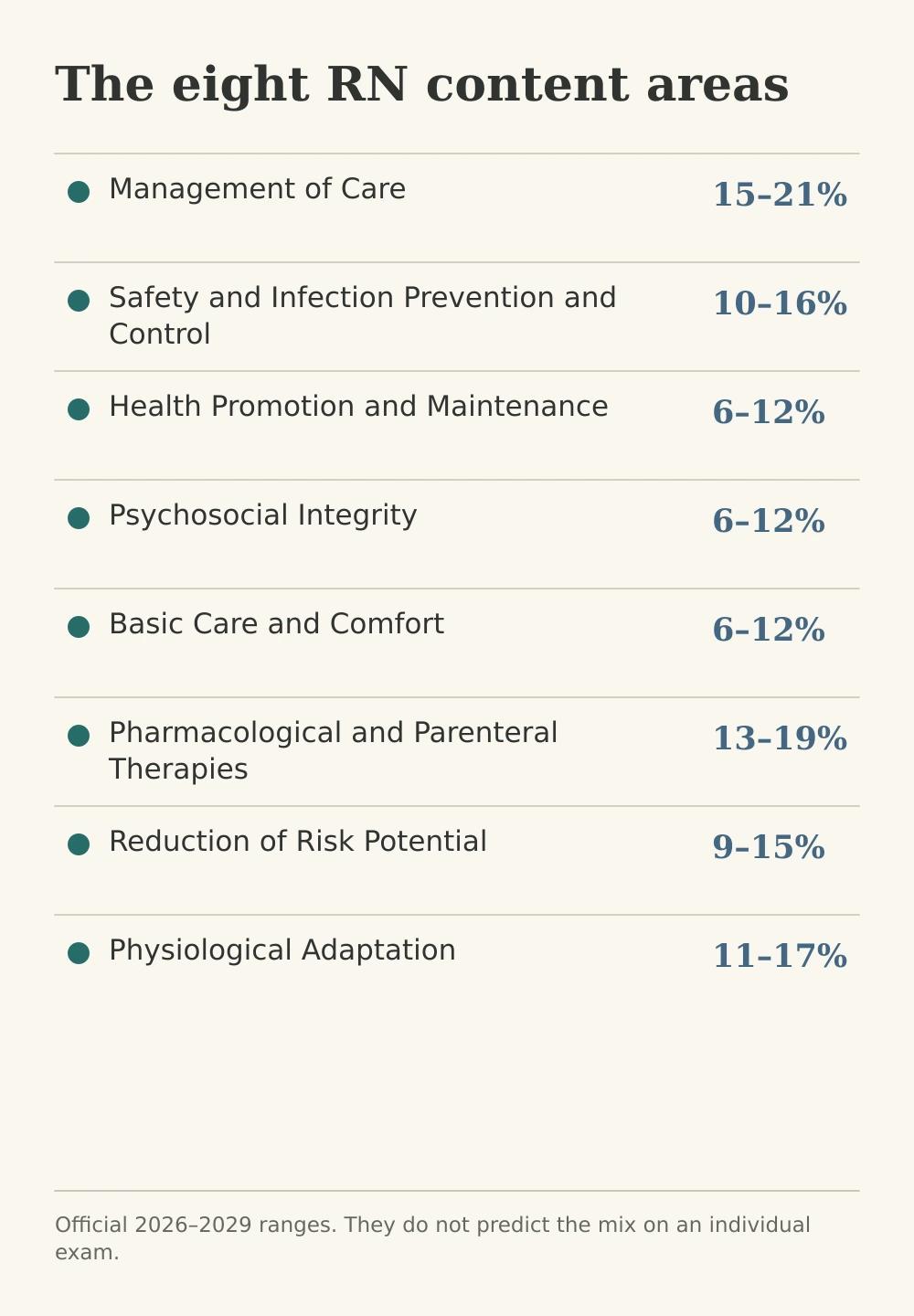
The eight content areas in the 2026 blueprint
NCSBN specifies these percentage ranges in the official RN test plan:
- Management of Care: 15–21%. Coordinating care, delegation, advocacy and professional responsibilities.
- Safety and Infection Prevention and Control: 10–16%. Reducing hazards and preventing transmission.
- Health Promotion and Maintenance: 6–12%. Development, screening and preventive care.
- Psychosocial Integrity: 6–12%. Therapeutic communication, coping and mental health care.
- Basic Care and Comfort: 6–12%. Assistance with daily needs and comfort measures.
- Pharmacological and Parenteral Therapies: 13–19%. Safe medication and parenteral therapy decisions.
- Reduction of Risk Potential: 9–15%. Monitoring and recognizing complications.
- Physiological Adaptation: 11–17%. Managing changes in physiological status.
These are blueprint ranges, not a promise that your exam will contain a particular number of questions in each category. Do not multiply the percentages by 85 and use the result to predict your personal test.
One clinical topic can cross several categories
Consider a practice scenario involving a postoperative patient. Checking whether another team member can perform a task draws on Management of Care. Assessing a new change in status draws on risk reduction or physiological adaptation. Reviewing an analgesic order adds medication safety. The clinical setting stays the same while the nursing responsibility changes.
For two concrete applications of these categories, review RN, LPN/LVN and UAP delegation decisions and laboratory results in patient context.
This is why “I finished the surgical chapter” is an incomplete measure of preparation. After reviewing a topic, practice at least three kinds of decisions: what to assess, what to do and what to reassess. Read the rationale for the choices you rejected as well as the answer you selected.
Turn the blueprint into study priorities
Start with a usable baseline
Complete fresh, mixed practice under conditions you can repeat. Record category results, but also note how many questions support each result. A weak score from four items is a signal to investigate, not a precise diagnosis of your knowledge.
Classify missed questions by cause. Did you lack a fact, overlook a cue, choose a reasonable action at the wrong time or misunderstand what the question asked? Those errors need different repairs. Rereading a chapter will not reliably fix a habit of answering before you identify the task.
Give weak areas more time without abandoning coverage
Suppose medication decisions and risk reduction repeatedly cause difficulty, while psychosocial questions are more consistent. Add focused review and fresh practice for the two weak areas. Keep a smaller recurring mixed block so that stronger categories stay active and neglected areas become visible.
Do not allocate study time solely according to exam weight. A heavily tested area deserves attention, but your baseline may show that a smaller category needs more work. Combine three signals: blueprint importance, recurring errors and the amount of evidence behind your category score.
Use checkpoints rather than an unchangeable calendar
At the end of each week, compare fresh practice with the previous week under similar conditions. Look for fewer repeated errors and better reasoning across categories. If a weakness persists, change the next week's work. If performance improves only on repeated items, confirm it with unfamiliar questions before moving on.
Clinical judgment belongs throughout the plan
The NCLEX FAQ describes three six-item clinical judgment case studies, plus stand-alone clinical judgment items. Case practice should therefore run alongside content review rather than wait until the final week.
For each unfolding case, write a short chain: relevant findings → likely concern → safe response → evidence of improvement. Keep it specific. “Monitor the patient” is weaker than stating which finding you would monitor and what change would require escalation.
Check that you are using the right examination plan
Use the RN document when preparing for the NCLEX-RN; the PN blueprint is a separate resource. Candidates educated outside the United States should also check their nursing regulatory body's eligibility instructions. The test plan describes examination content; it does not replace licensing requirements or decide which credentials a board will accept.
Keep the official plan available as a coverage checklist. You do not need to memorize every line before you can study effectively. Work through its activity statements when a category feels abstract, then connect those statements to the decisions in your practice questions.
In ENDPEAK, the Study Plan can help organize this review. Use an Initial Diagnostic as a starting point and revisit priorities with fresh practice results. A schedule is useful when it changes in response to what you learn.
References and editorial note
Sources: NCSBN test plans, 2026 RN Test Plan and NCLEX FAQs. Study methods and examples are ENDPEAK's educational interpretation, not NCSBN prescriptions. ENDPEAK is not affiliated with NCSBN and does not guarantee a passing result.
Once your study priorities are clear, place them in an adaptable six-week study plan. For case practice, work through our step-by-step NGN case study guide, then use the QBank score interpretation checklist to review progress without treating a percentage as a passing guarantee.
For the medication category, use our NCLEX pharmacology review to turn drug families into specific assessment, monitoring and patient-safety questions.
ENDPEAK publishes independent NCLEX-RN study resources. Exam rules are checked against official NCSBN sources. Original teaching examples are identified as such, and clinical review is credited only when it has actually occurred. ENDPEAK is not affiliated with or endorsed by NCSBN.