NCLEX Delegation Questions: RN, LPN/LVN and UAP Decisions
Use four original scenarios to distinguish assignment, delegation and nursing judgment, with checks for scope, competence, communication and supervision.

Which task can the RN safely give to a UAP? Consider a stable adult whose RN-assessed care plan includes recording oral intake and urine output. The UAP is competent to measure those amounts. The other proposed responsibilities are deciding whether the fluid plan should change and assessing newly reported dizziness.
Scope: These are original ENDPEAK teaching scenarios, not official NCLEX items or clinical protocols. They have not received independent professional nursing review. Assume stated activities are authorized and competence is verified unless the case says otherwise; actual delegation depends on jurisdiction, setting policy and patient needs. Sources checked in October 2026: NCSBN–ANA delegation guidance, the 2026 RN Test Plan and the cited regulator resources.
Best fit: measuring and recording the specified amounts. The activity has defined steps and reporting expectations. Changing the plan requires interpretation. New dizziness changes the information the nurse must assess. The UAP should report that symptom rather than decide whether it is harmless.
A strong rationale names both sides of the boundary: the UAP can collect the specified observations, while the nurse interprets them and evaluates the patient's response. “UAP can do I&O” is an incomplete explanation.
The answer turns on a boundary: collecting specified observations versus making the nursing decision those observations may require. NCLEX delegation questions test that boundary alongside scope, patient condition, competence, communication and follow-up.
Separate assignment, delegation and handoff
The NCSBN–ANA National Guidelines for Nursing Delegation distinguish routine work within a person's authorized role from a nursing responsibility transferred through a delegation process. Assignment distributes care already within that role. Delegation requires authority, appropriate preparation and a safe process for the specific responsibility. Transferring care between licensed clinicians can instead be a handoff.
Study resources sometimes use “delegate” more broadly than these definitions. Read the question's actual request. “Which patient should be assigned to the LPN?” is not identical to “Which activity may the RN delegate to assistive personnel?” Neither question asks you to transfer the RN's clinical reasoning to someone else.
These distinctions matter in the NCLEX-RN Management of Care blueprint. They also prevent a familiar mistake: treating every team member as interchangeable once a task sounds simple.
RN, LPN/LVN and UAP: use roles without inventing universal task lists
The RN coordinates the nursing decisions
In an RN-level exam scenario, keep comprehensive assessment, care planning and evaluation with the appropriately qualified RN. The RN must decide whether the proposed transfer is appropriate and respond when the situation changes. Collecting a temperature is not the same activity as interpreting new fever with deterioration.
The LPN/LVN is a licensed nurse
An LPN or LVN is not a UAP with a longer task list. Practical/vocational nursing includes licensed care within a defined scope, often with direction or supervision. Depending on the jurisdiction and setting, it can include focused assessment or data collection, established treatments and reinforcement of an existing teaching plan. Do not assume every LPN is prohibited from all assessment, or authorized for every medication or procedure.
For example, the Texas Board of Nursing distinguishes an LVN's focused assessment from an RN's comprehensive assessment. That is an illustration of a jurisdiction's rules, not a national permission slip. NCSBN notes that some jurisdictions allow LPN/VNs to delegate; Texas places different limits on that authority.
UAP/AP supports care within an authorized role
UAP means unlicensed assistive personnel. The national guidelines use assistive personnel, or AP, for trained support workers with different titles. Routine assistance with hygiene, mobility or measured intake and output may be appropriate when the care plan, patient condition, role and competence support it. Deciding whether a new symptom changes that plan remains a nursing judgment.
Read NCSBN's delegation guidance alongside the applicable nurse practice act, regulations and employer policy. A facility may restrict practice further; it cannot authorize what the law prohibits. On an educational question, use the stated setting and permissions rather than importing an exception from a job you have held.
Make the Five Rights answer a concrete safety question
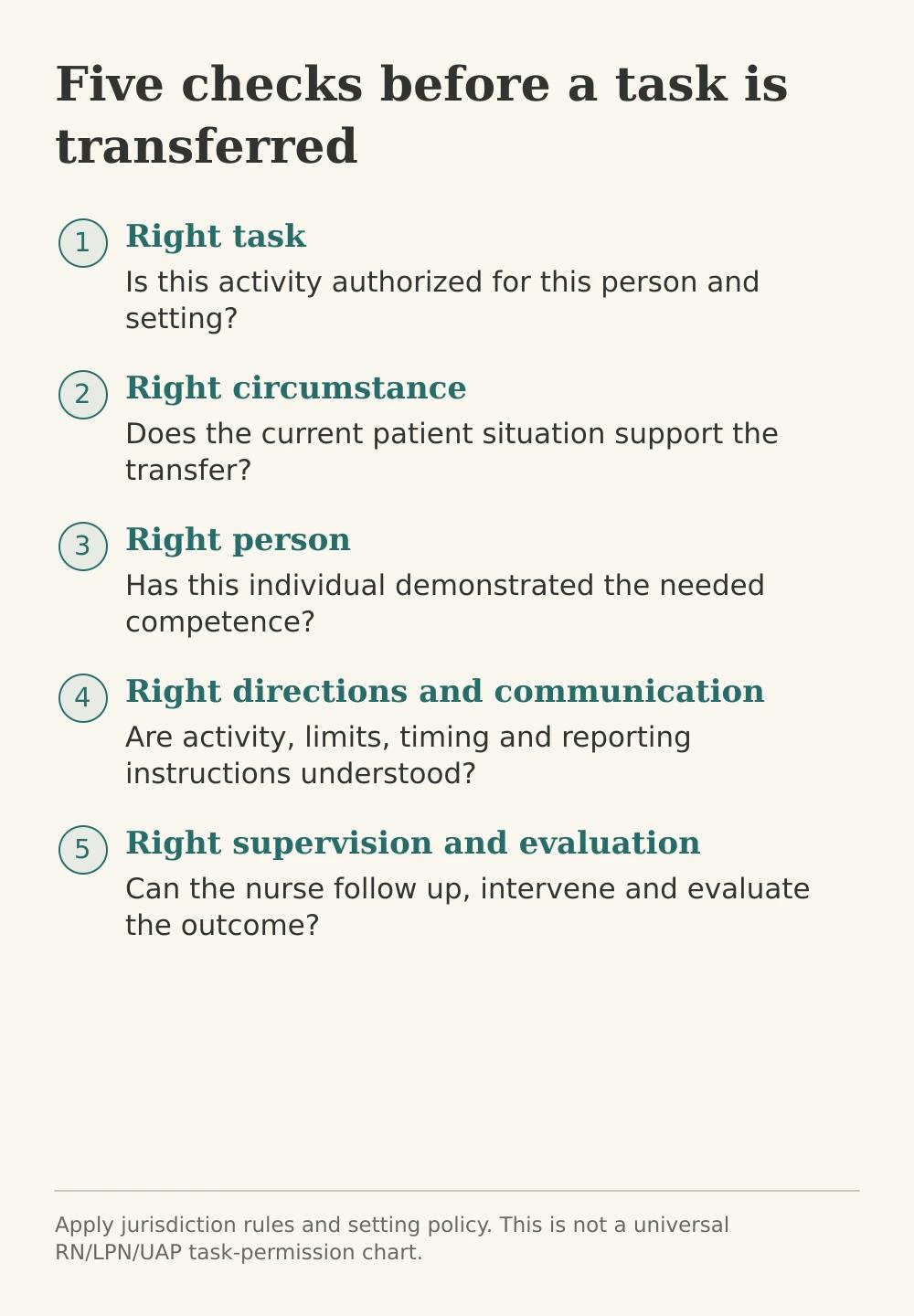
The Five Rights are most useful when you turn each one into a check on the proposed decision. The labels alone do not explain why an option is safe.
- Right task: Is this specific activity permitted for this person in this setting?
- Right circumstance: Is the current situation suitable, with a sufficiently stable and predictable patient response?
- Right person: Has this individual demonstrated the necessary competence?
- Right directions and communication: Are the task, limits, timing and reporting instructions clear, and understood?
- Right supervision and evaluation: Can the nurse monitor completion, intervene and evaluate the outcome?
“Take care of room 4” answers none of those questions well. A better instruction identifies the activity and its boundaries, explains what changes must be reported and establishes when the nurse will follow up. Communication is two-way: the recipient needs an opportunity to clarify and accept the responsibility.
Use this original decision map when reviewing practice answers. It summarizes a reasoning approach; it does not replace a jurisdiction's delegation rules.
Three more decisions: test the boundary
Keep the same scope assumptions for the following three scenarios. Each changes a different part of the decision: the care plan, the patient response or the worker's preparation.
A. Established care versus a new care decision
A competent LPN can perform a prescribed routine dressing change under the facility's policy. One patient's wound has an established plan and no reported change. Another has a newly recognized wound problem requiring assessment and a revised plan. Which assignment best fits the stated permissions?
The established dressing change is the better fit. The question has supplied the scope and competence information. The new problem requires RN assessment and coordination before treating it as routine. This does not mean that an LPN cannot observe the wound, provide licensed care within scope or report a change. It means the RN cannot hand away responsibility for the new nursing decision.
B. A familiar activity becomes unsuitable
A UAP is helping a patient with a planned walk after the RN's assessment. The patient now reports lightheadedness on standing. Should the UAP continue because walking was already assigned, or stop the activity safely and notify the nurse?
Stop safely and notify the nurse. The original plan was based on earlier information. The changed response requires reassessment. This tests the right circumstance and communication, not whether walking belongs on a memorized list of UAP tasks. The RN then determines appropriate next care.
C. Experience does not remove the need for competence
A support worker has years of experience on the unit but has not completed the required preparation for a newly introduced device-related activity. The unit is short-staffed. Is experience alone enough to delegate that activity?
No. General experience does not establish competence for a specific responsibility. The nurse needs an authorized, prepared person and an achievable supervision plan. Workload explains why help is needed; it does not supply missing training.
What remains with the delegating nurse?
The nurse remains accountable for the delegation decision, necessary supervision and evaluation. The recipient remains responsible for accepting work within competence, performing it correctly and reporting relevant information. Accountability is not a choice between “everything is the RN's fault” and “the task is no longer the RN's concern.” The organization also has responsibilities for safe policies, training and staffing.
For practice review, finish the answer with a follow-up sentence: “I would check completion and reassess if the patient changes.” If the proposed assignment leaves nobody available to do that, reconsider its safety. The 2016 NCSBN guidelines explain these connected responsibilities in more detail.
A final communication check
Prioritization compares urgency; delegation determines who may perform a responsibility and how the nurse will oversee it. When practicing team assignments, answer both questions separately rather than using “stable” as the entire rationale.
Return to the walking scenario. Rewrite the assignment as an instruction that identifies the planned activity, the symptom that should stop it, whom to notify and when the nurse will follow up. “Help this patient walk” leaves the safety boundary unstated. Your revised instruction should make that boundary clear without asking the UAP to diagnose the lightheadedness.
ENDPEAK publishes independent NCLEX-RN study resources. Exam rules are checked against official NCSBN sources. Original teaching examples are identified as such, and clinical review is credited only when it has actually occurred. ENDPEAK is not affiliated with or endorsed by NCSBN.