NCLEX Prioritization Questions: Which Patient Should You Assess First?
Practice patient-priority comparisons with original scenarios, changing cues and clear explanations of why common mnemonics are useful but not absolute.

Two patients need care. One has a familiar diagnosis with a new alarming finding; the other has a serious diagnosis but is unchanged from their documented baseline. Choosing by diagnosis alone can put you in the wrong room first.
NCLEX prioritization questions ask you to compare the current situation: what could cause serious harm if care is delayed, what has changed and what the nurse needs to do now. A mnemonic helps only when it fits that evidence.
Start by separating “who first” from “what first”
“Which patient should the nurse assess first?” asks you to rank patients. “Which action should the nurse take first?” asks you to sequence care for a particular situation. The same urgent cue may appear in both, but the answer choices do different work.
Before reading the options, identify the task and setting. A bedside nurse with an established assessment, a nurse receiving report and a responder finding an unresponsive adult do not all need the same initial step. Do not import information or resources that the question never supplies.
Use the NCLEX-RN test-plan guide for the broader blueprint. This page focuses on comparing urgency within a question, not on memorizing category weights.
If the question instead asks who may perform a responsibility, use the delegation decision guide to separate scope, competence and supervision from the urgency comparison.
What makes a finding urgent?
Ask what the finding says about immediate safety. Evidence of airway compromise, failing ventilation or poor circulation deserves prompt attention. So do other time-sensitive threats, including a sudden neurologic deficit. “The patient is breathing” does not establish that everything else can wait.
Next, compare the finding with the patient's baseline. Stable means there is evidence of stability: no new deterioration, relevant observations unchanged and current needs safely addressed. It does not mean the patient has a chronic condition. A chronic condition can develop an acute complication.
Finally, consider the consequence of delay. Routine teaching may be useful but poorly timed during an emergency. An expected finding can still be dangerous if its severity or trajectory changes. “Expected” should not become permission to ignore it.
Three original scenarios to test the comparison
These simplified adult teaching scenarios are original ENDPEAK material, not official NCLEX questions. The clinical facts are supported by the sources linked below; the scenarios have not received independent professional nursing review. In practice, use the applicable emergency response procedures, current orders and facility policies.
Scenario 1: A chronic diagnosis does not make a new finding routine
You receive report on four patients. One has longstanding hypertension and, within the past few minutes, developed one-sided arm weakness and slurred speech. Another has unchanged chronic knee pain and is awaiting a scheduled analgesic. A third is ready for routine discharge teaching. The fourth needs help selecting breakfast; no new concerns are reported for these three patients.
Assess the patient with the sudden neurologic change first and promptly initiate the setting's stroke/emergency response process. The CDC identifies sudden one-sided weakness and speech difficulty as stroke warning signs. Do not delay because the patient has a chronic diagnosis or can still speak.
The other needs remain real, but none of their stated findings indicates a comparable time-sensitive threat. The answer is supported by the new neurologic deficit, not by an assumption that patients with hypertension are always the highest priority.
Scenario 2: Two adverse effects do not have the same urgency
A patient taking lisinopril reports new tongue swelling and difficulty swallowing. Another reports an unchanged dry cough that was previously assessed, with no breathing difficulty or swelling. Two other patients need routine care and have no new abnormal findings.
The patient with tongue swelling requires immediate assessment and emergency escalation. Lisinopril can cause angioedema; involvement of the tongue or larynx can obstruct the airway. The prescribing information describes this risk. An unchanged cough still warrants appropriate follow-up, but it is not equivalent to the stated airway threat.
Change one cue and reconsider: if the patient with the cough now has severe respiratory distress, you can no longer call that patient stable. The earlier ranking depended on the earlier findings. This is why a memorized “side effect versus adverse reaction” label is less useful than understanding what is happening.
Scenario 3: “Assess before acting” has limits
A nurse has identified an adult who is unresponsive, has no normal breathing and has no definite pulse within the brief BLS pulse check. The emergency response system has been activated and another responder is obtaining the AED.
At this point, collecting a full history or completing a routine assessment would delay resuscitation. The AHA adult BLS guidance supports starting CPR with chest compressions and using the AED as soon as available. This cardiac-arrest sequence shows why “airway always comes first” is not a universal answer rule.
The lesson is narrow: once an emergency requiring immediate action is identified, do not repeat a broad assessment just to satisfy a slogan. When essential information is missing and no emergency is established, focused assessment may instead be the appropriate first step.
Use ABCs, acute/chronic and actual/risk as checks
ABCs direct attention to vital functions. They do not turn every option mentioning breathing into a higher priority than every neurologic or circulatory problem. Compare evidence, severity and urgency; a stable patient with a respiratory diagnosis does not automatically outrank someone with a new time-sensitive deficit.
“Acute before chronic” is a useful prompt to notice change, not a license to sort diagnoses into permanent priority levels. A familiar chronic illness with new instability may be more urgent than a minor new problem.
“Actual before potential” also needs context. A minor existing discomfort does not necessarily outrank an imminent threat of serious harm. In a question, make the risk concrete: what event is about to happen, how serious would it be and what evidence supports it? Do not create a hypothetical catastrophe that is absent from the stem.
Write a rationale that explains the delay
When reviewing a missed item, explain two things: why the chosen patient needs attention now and why each alternative can wait briefly on the facts given. “Because ABCs” leaves too much unexplained.
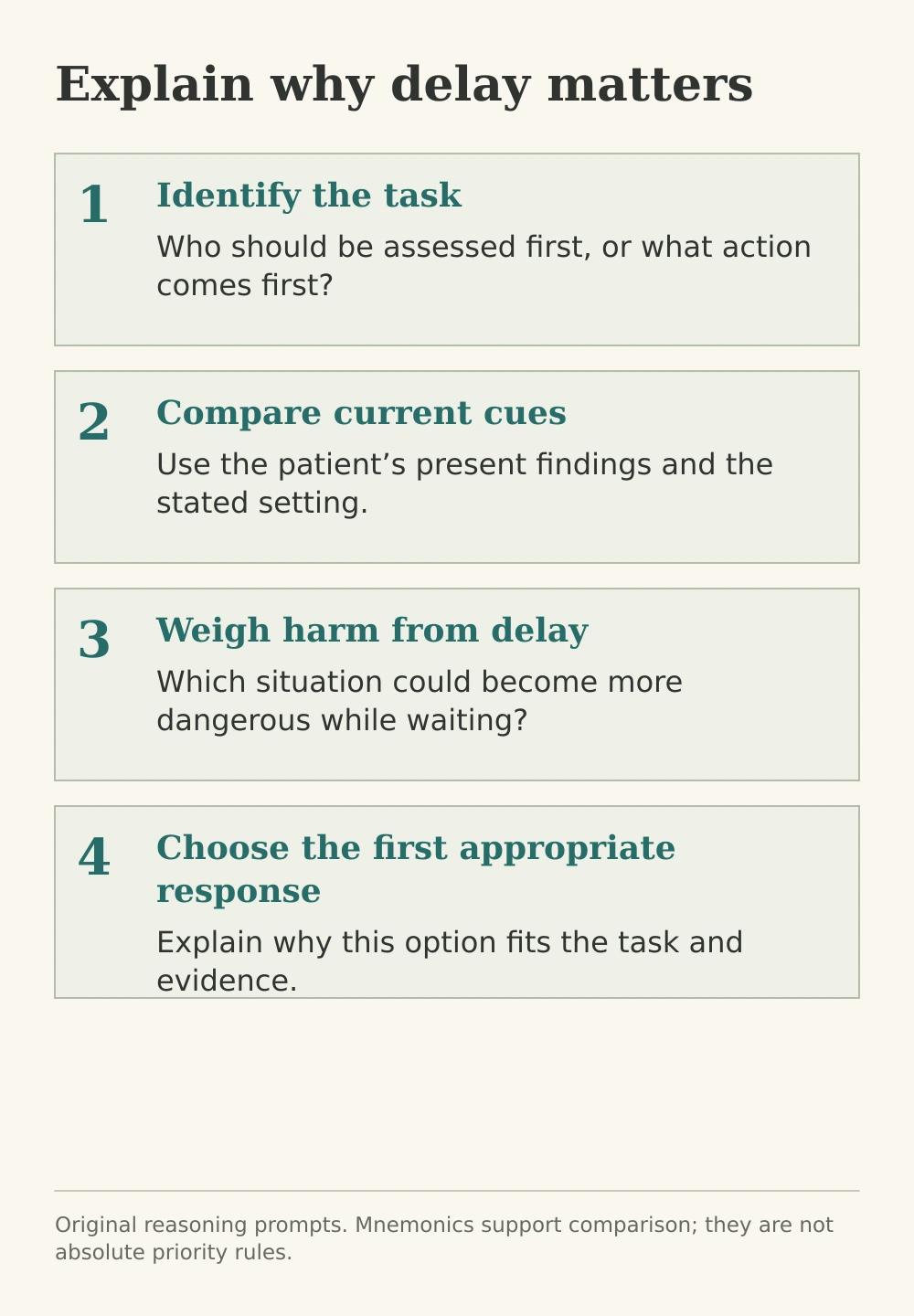
Try this original review format: cue → threat → consequence of delay → first appropriate response. Then alter one cue and rank the patients again. This tests whether you understand the comparison rather than recognize a familiar answer.
For decisions that change across several screens, work through the NGN case-study guide. For medication-related cues, use the pharmacology review method to connect an effect with the assessment it requires.
ENDPEAK's QBank, RN Topics and AI Tutor can support this practice and review. The study tools require an account and applicable access. Use explanations to examine your reasoning, and verify clinical claims against current references rather than treating any AI explanation as clinical authority.
Clinical references
CDC stroke warning signs; DailyMed lisinopril labeling; 2025 AHA adult BLS guidelines; 2026 RN test plan. Checked October 2026. The comparison framework is educational guidance, not a clinical triage protocol.
ENDPEAK publishes independent NCLEX-RN study resources. Exam rules are checked against official NCSBN sources. Original teaching examples are identified as such, and clinical review is credited only when it has actually occurred. ENDPEAK is not affiliated with or endorsed by NCSBN.