Sepsis NCLEX: Recognizing Deterioration and Nursing Priorities
Follow one adult patient’s changing observations to recognize worsening perfusion and explain when nursing assessment and escalation cannot wait.

At 9:00 a.m., a patient admitted with a suspected respiratory infection is awake, answering questions, and not reporting severe pain. His blood pressure is 116/70 mm Hg. What changes the assessment is that he is slower to respond than earlier, his respiratory rate has risen, and the urine collection shows only 20 mL over the preceding hour.
For sepsis NCLEX questions, the challenge is often recognizing that these findings belong together before the blood pressure becomes dramatically low. The following original educational case follows one patient's changing condition. Its times illustrate reassessment; they are not instructions to wait between actions.
9:00 a.m.: The first concern is the change from baseline
The patient is 63 and was alert an hour ago, with a heart rate of 82/min, respirations of 16/min, and blood pressure of 138/80 mm Hg. He now has a heart rate of 96/min, respirations of 22/min, a temperature of 37.7°C, and oxygen saturation of 94% on room air. He needs a question repeated before answering.
A temperature below a traditional fever cutoff does not cancel the other findings. Nor does a blood pressure that has not yet reached a severe hypotensive range establish adequate perfusion. New mental-status changes, decreasing urine output, and a rising respiratory rate warrant a focused assessment and prompt communication.
The RN checks airway and breathing, verifies the observations, evaluates circulation and perfusion, reviews intake and output, and assesses potential infection sources. A low urine measurement also requires checking whether collection is reliable or a catheter is obstructed, when applicable. That check happens alongside assessment of the patient; it does not explain away a cluster of deterioration.
The appropriate response is to escalate concern now using the facility's deterioration or sepsis pathway. For the broader decision about which patient needs attention first, see NCLEX prioritization questions. Here, the focus is how the evidence for worsening perfusion develops.
What makes an infection become sepsis?
Sepsis is life-threatening organ dysfunction caused by a dysregulated response to infection. An infection alone is not synonymous with sepsis. The important shift is evidence that organ function is being affected: for example, altered mentation, impaired kidney function, worsening oxygenation, or circulatory abnormalities in the appropriate clinical context.
Those findings are not unique to sepsis. Bleeding, dehydration, pulmonary embolism, and cardiac problems can also cause deterioration. The RN recognizes and communicates the emergency while the team investigates its cause, rather than waiting to prove one diagnosis at the bedside.
9:10 a.m.: The trend is now more concerning
While the responding team is assessing him, the heart rate is 112/min, respirations are 28/min, blood pressure is 94/58 mm Hg, and oxygen saturation is 91% on room air. He is increasingly confused. These are new findings to report immediately, not data to save for the next routine observation round.
The direction of change matters. An isolated heart rate might have several explanations; falling blood pressure together with worsening breathing and mentation suggests compromised circulation and escalating illness. Assessing skin temperature, capillary refill, pulses, work of breathing, and urine output adds information about perfusion and respiratory status.
The RN supports airway and breathing, administers oxygen according to orders or an applicable emergency protocol, ensures appropriate access and monitoring, and assists with time-sensitive evaluation and treatment. Immediate bedside assessment and escalation should not be replaced by a lengthy chart review or a laboratory result that has not returned.
What a useful escalation sounds like
An effective report links a suspected source to specific changes: “He has a suspected respiratory infection and new confusion. His pressure has fallen from 116/70 to 94/58 in ten minutes, his respiratory rate is now 28, and urine output was 20 mL over the previous hour. I am concerned about worsening perfusion and need urgent bedside review.”
This report communicates an assessment and a request. Saying only “the patient may be septic” leaves out the observations that help the team judge urgency.
9:15 a.m.: A lactate result supports concern, but does not replace assessment
Blood pressure is now 84/50 mm Hg, heart rate 120/min, and respirations 30/min. The laboratory reports a lactate of 3.6 mmol/L. The patient remains confused.
In this context, an elevated lactate adds to concern about severe illness and impaired perfusion. It does not independently diagnose sepsis or identify its cause. Lactate can rise through several mechanisms, and a normal value would not make new hypotension and confusion safe to ignore. Interpret the result with the examination and trend, as described in the NCLEX lab values guide.
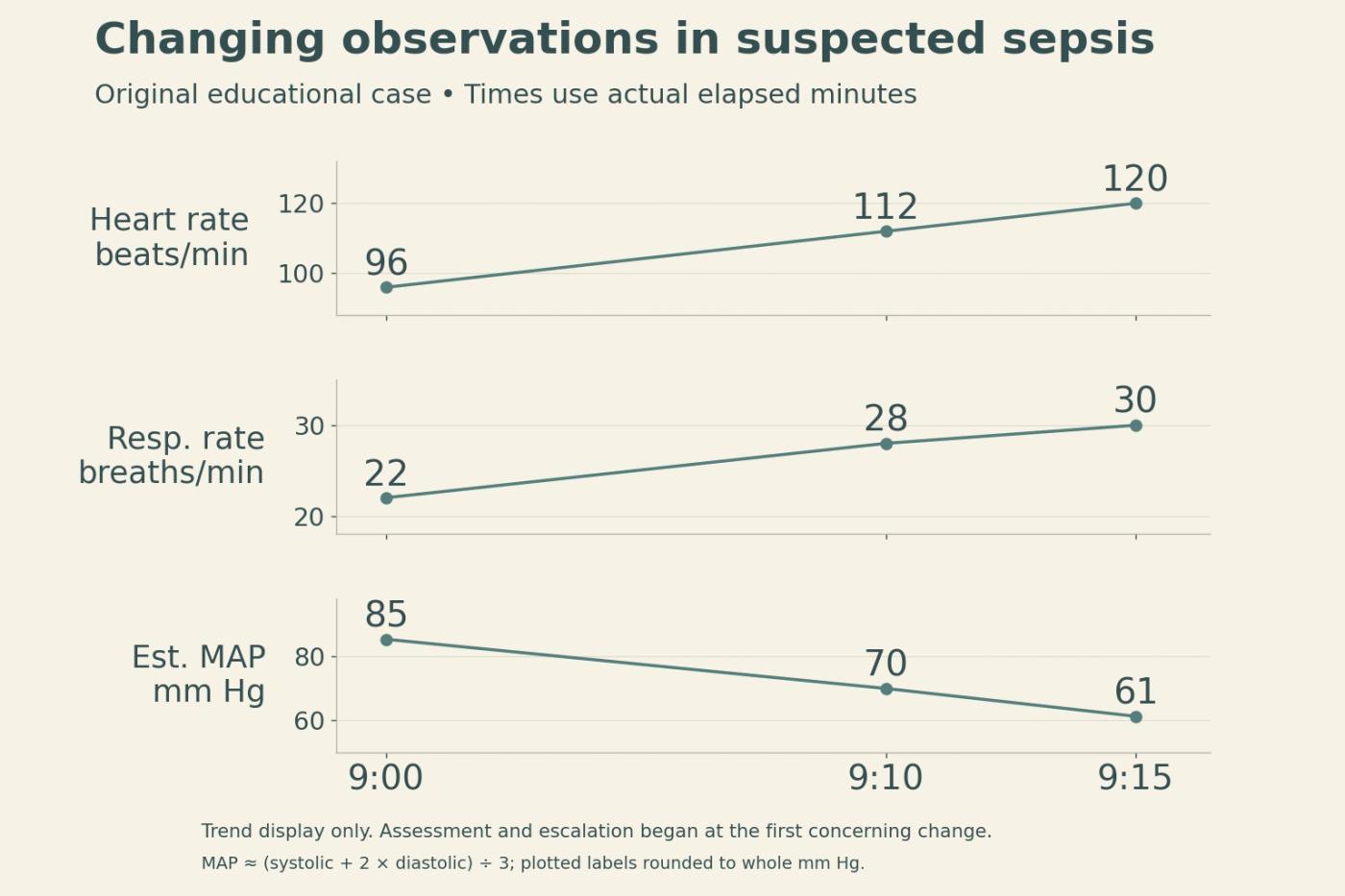
The estimated mean arterial pressure falls from approximately 85 to 70 to 61 mm Hg across the three observations. These estimates use (systolic pressure + 2 × diastolic pressure) ÷ 3. They help display the trend; they are not a substitute for clinical evaluation or an individualized hemodynamic goal.
Suspected shock needs action before every definition is satisfied
Septic shock is a particularly severe subset of sepsis. The Sepsis-3 clinical criteria include a vasopressor requirement to maintain a mean arterial pressure of at least 65 mm Hg and lactate above 2 mmol/L despite adequate volume resuscitation.
Our case has not supplied all of those conditions, so calling it confirmed septic shock would overstate the evidence. It nevertheless describes an unstable patient with suspected infection who needs an emergency response. Formal classification must not become a reason to delay care.
What the 2026 Surviving Sepsis Campaign changes about a memorized answer
The 2026 adult guidelines favor NEWS/NEWS2, MEWS, or SIRS over qSOFA as a single hospital screening tool. qSOFA neither establishes nor excludes sepsis.
The guidelines call for immediate antimicrobials, ideally within an hour, for septic shock or probable or definite sepsis. Possible sepsis without shock requires rapid investigation and antimicrobials within three hours if concern persists. Our hypotensive patient needs emergency assessment now.
Obtain cultures promptly, ideally before antimicrobials, without harmful treatment delays. Fluid and vasopressor decisions require reassessment; a memorized fluid volume is not permission to ignore possible overload.
For nursing reasoning, ask what is changing after each intervention: perfusion, breathing, mental status, urine output, blood pressure, and relevant laboratory trends. Serial lactate can contribute, but continuing fluids solely until lactate normalizes is not an appropriate universal rule.
The next observation should answer a clinical question
After treatment begins, “repeat the vital signs” is more useful when tied to a question: Is circulation improving? Is breathing becoming more difficult? Is the patient more alert? Is urine output recovering? Has a new problem appeared?
Rapid breathing and altered consciousness also occur in metabolic emergencies. The DKA versus HHS review examines that different context. In either setting, the RN should recognize instability, communicate the trend, and reassess the response rather than use one finding to settle the entire diagnosis.
When practicing in ENDPEAK's QBank, pause at the first meaningful change in a sepsis scenario and state why it warrants escalation. The essential decision in this case occurred at 9:00 a.m., before the most dramatic numbers arrived.
Sources and scope
This is an original educational case, not a treatment protocol or a report of a real patient. Clinical actions depend on the patient's condition, authorized orders, professional scope, and local emergency procedures.
- SCCM: Surviving Sepsis Campaign adult guidelines, 2026.
- SCCM: Sepsis definitions.
- CDC: About sepsis.
- MSD Manual Professional: Sepsis and septic shock, reviewed April 2026.
ENDPEAK publishes independent NCLEX-RN study resources. Exam rules are checked against official NCSBN sources. Original teaching examples are identified as such, and clinical review is credited only when it has actually occurred. ENDPEAK is not affiliated with or endorsed by NCSBN.