What Is a Good NCLEX QBank Score? How to Measure Your Readiness
Interpret practice percentages in context: fresh versus repeated questions, testing conditions, category coverage and the errors you keep making.
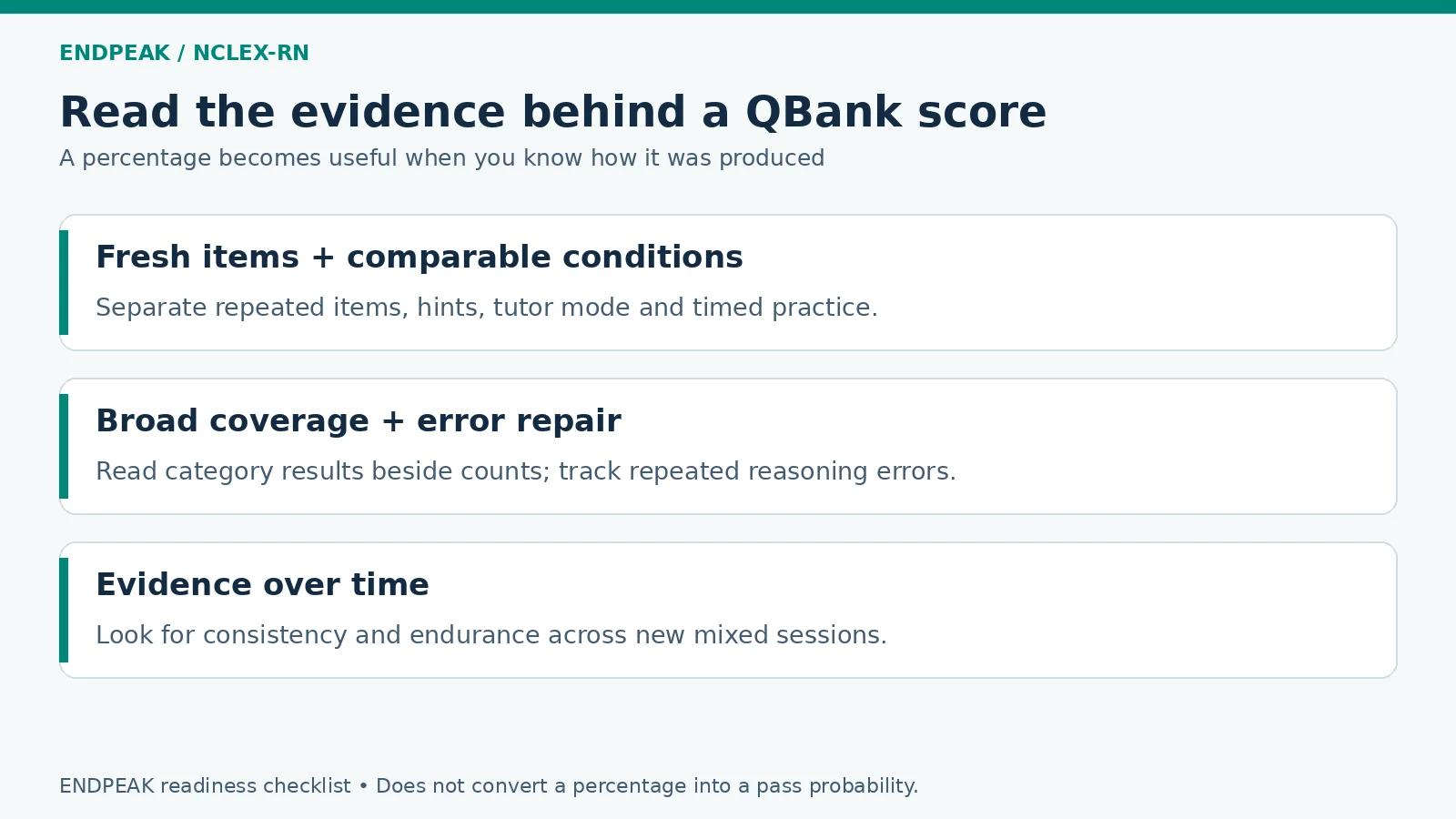
A 70% QBank score can describe very different performances. One candidate answered unfamiliar mixed questions without hints. Another repeated a favorite set immediately after reading its rationales. The percentages match; the evidence does not.
There is no universal QBank percentage that NCSBN recognizes as proof that you will pass the NCLEX-RN. A score is useful when you know how it was produced and what decisions it reveals.
Why a practice percentage is not the NCLEX passing standard
The NCLEX uses adaptive measurement of ability. The official RN passing standard is expressed on a logit scale, currently 0.00 logits. It is not a requirement to answer a fixed percentage of a commercial question bank correctly.
Different banks use different questions, difficulty levels, scoring methods and practice settings. Even within one bank, selecting only strong topics changes the meaning of the result. Do not compare percentages from different products as though they were the same test.
If a vendor provides a readiness benchmark or probability, check its definitions, the population used to validate it and the conditions under which it applies. A product claim should not be relabeled as an official NCSBN prediction.
First, ask what went into the score
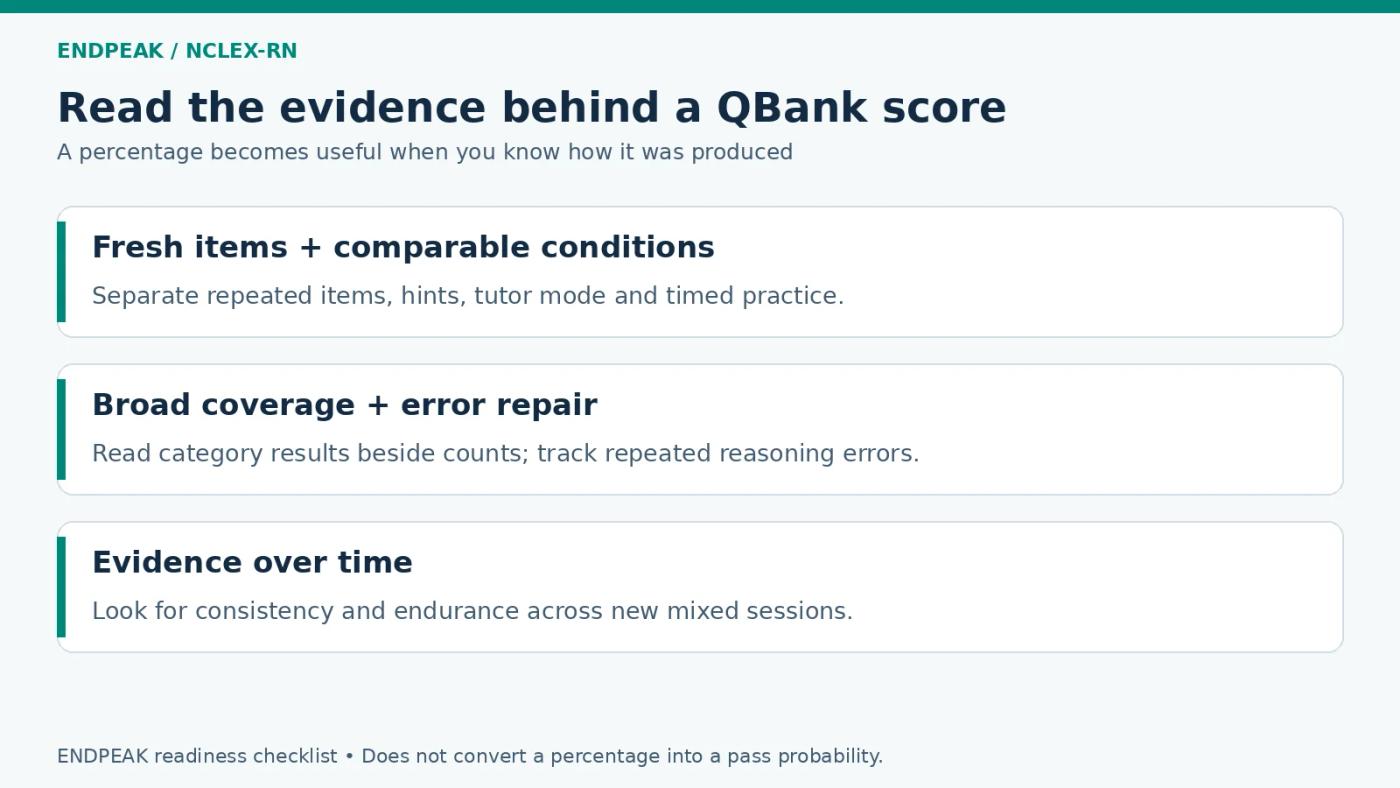
Were the items fresh?
Repeated items are useful for learning and checking recall. Keep their results separate when assessing readiness. Improvement can reflect memory of wording or answer positions rather than improved reasoning on unfamiliar problems.
A small set of fresh questions will still be noisy. Use it as one observation in a series, not a final verdict. There is no need to invent a precise readiness probability from a thin sample.
Were the conditions comparable?
Tutor mode, hints, open notes and untimed work serve learning goals. Timed, closed-note mixed practice asks a different question: can you retrieve and apply knowledge without those supports?
Label the conditions in your log. Compare like with like before calling a score change improvement. If you switch settings, establish a new baseline rather than treating the difference as a clean trend.
Did the practice cover the blueprint?
A strong overall score can coexist with an important gap. Check the RN Client Needs categories, along with clinical judgment practice, instead of using your average to erase a recurring weakness.
Always read category percentages beside item counts. For example, three correct answers out of four gives 75%, but one answer changes that percentage by 25 points. This arithmetic example explains instability; it is not a recommended sample size or a readiness threshold.
Look below the percentage at the errors
Two missed questions may need different responses. Not knowing a medication effect calls for content repair. Recognizing an urgent finding but choosing delayed teaching instead of an immediate response calls for priority work. Misreading “requires follow-up” calls for attention to the task.
Track whether the same error returns on a new item. If a percentage rises while the same unsafe priority choice persists, keep that problem on your review list. Conversely, a temporary lower score in a harder fresh set may reveal a useful learning opportunity rather than erased progress.
A readiness review you can use each week
- Fresh mixed practice: Are results becoming more consistent under comparable conditions?
- Coverage: Have you practiced across the RN blueprint rather than mainly in comfortable areas?
- Clinical judgment: Can you connect cues, priorities, actions and outcomes in an unfolding case?
- Error repair: Do previously identified mistakes recur less often on new material?
- Endurance: Can you maintain reasoning and pacing through longer sessions?
Use the review to make a concrete next decision. If content is broadly sound but prioritization errors repeat, spend the next block comparing urgent and less urgent actions. If results depend on hints, add closed-note practice. If coverage is narrow, broaden the next mixed set.
What to do when a score worries you
Before buying another resource or abandoning your schedule, inspect the session. Was it mostly a weak topic? Were you tired? Did scoring include partial credit differently? Did you rush the final items? Those explanations do not excuse errors; they help choose the right repair.
Then confirm your interpretation with fresh practice after review. One strong session should not erase a pattern of gaps, and one disappointing session should not erase weeks of more consistent evidence. If uncertainty remains substantial, discuss your preparation with a qualified nursing educator.
ENDPEAK's Performance feature can help you follow patterns across practice. Use the QBank to test whether a repaired concept transfers to unfamiliar questions. Keep any practice-platform assessment separate from the official NCLEX outcome.
Sources and limits
NCSBN passing standard; NCSBN CAT explanation; NCSBN test plans. The readiness checklist is ENDPEAK's educational interpretation, not a validated prediction model. No isolated percentage establishes that you will pass.
If your review shows recurring gaps, use our adaptable six-week NCLEX study plan to turn those findings into the next week of work. For a practice CAT result that leaves you wondering about question count, read what 85 versus 150 questions really means.
Before comparing scores across sessions, check what each format is designed to do. Our CAT practice test versus fixed exam comparison explains how selection, timing and feedback affect the evidence you can take from a result.
ENDPEAK publishes independent NCLEX-RN study resources. Exam rules are checked against official NCSBN sources. Original teaching examples are identified as such, and clinical review is credited only when it has actually occurred. ENDPEAK is not affiliated with or endorsed by NCSBN.