NCLEX 85 vs. 150 Questions: What Your Exam Length Really Means
An early stop and a full-length exam can each end in a pass or a fail. Understand the CAT stopping rules and what question count cannot tell you.

The screen goes blank at question 85. Or it keeps going until question 150. In either situation, the question count can feel like a verdict. It is not one.
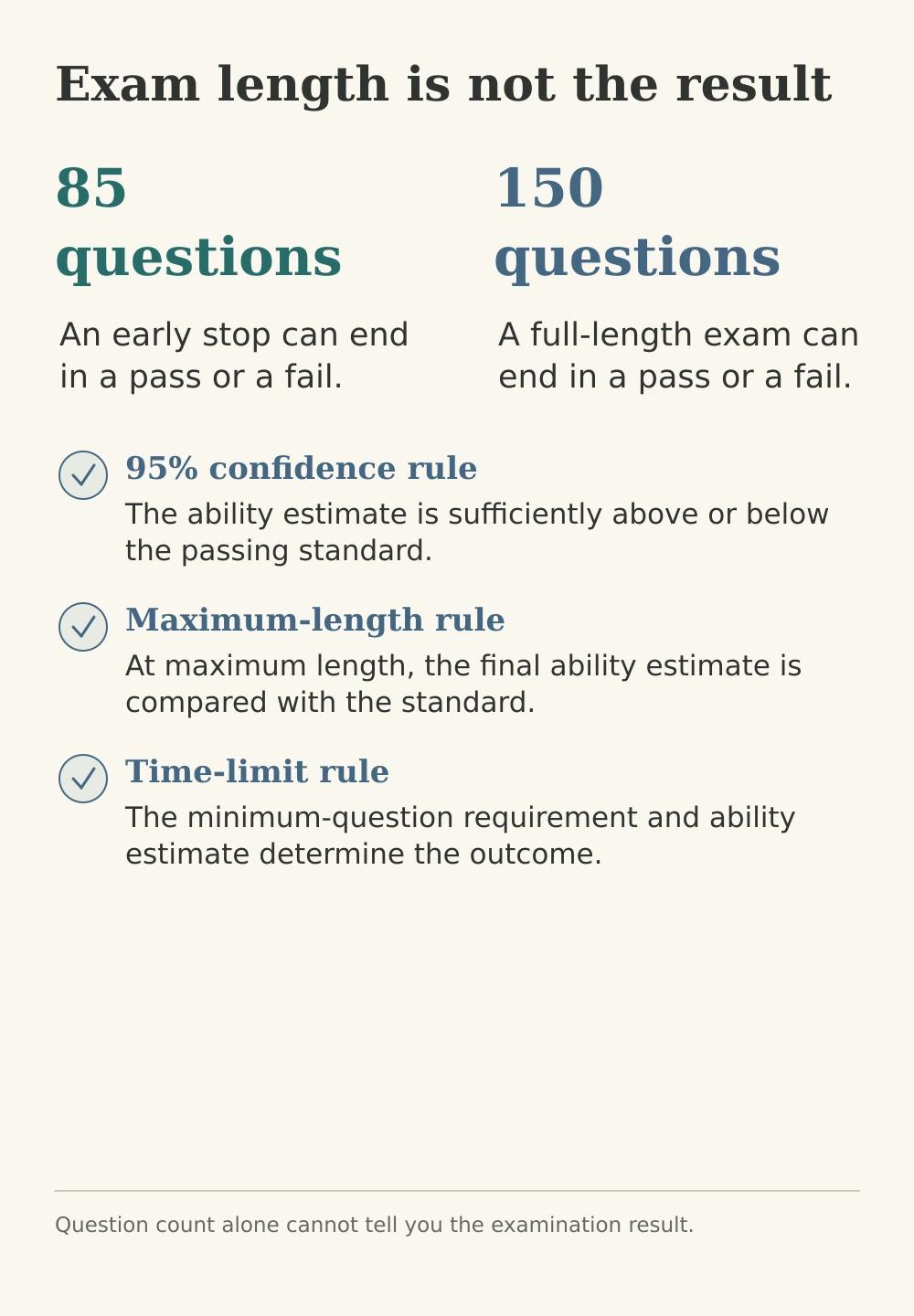
The NCLEX-RN uses computerized adaptive testing (CAT). The examination is evaluating ability relative to the passing standard, not rewarding candidates for stopping early. Both a short exam and a maximum-length exam can end in a pass or a fail.
What 85 and 150 actually describe
According to the official NCLEX FAQ, the RN examination contains 85–150 items, with up to five hours including breaks. Fifteen items are unscored pretest items. You cannot identify those items while testing, so treat every question as worth your attention.
The range describes how many items the examination may administer. It does not set a passing percentage. Nor does it mean that everyone who answers the same number of questions has performed similarly.
How CAT uses your answers
After each response, CAT updates its estimate of your ability and selects an appropriate next item while meeting examination requirements. NCSBN's CAT explanation describes this process and its stopping rules.
A useful distinction is difficulty versus decision. An item that feels difficult to you is not a visible readout of the algorithm. An unfamiliar topic, fatigue or wording can change your experience of difficulty. You do not have access to the item parameters or your running ability estimate.
Likewise, getting the final question right or wrong cannot reliably tell you the outcome. The exam does not turn one remembered answer into a public pass/fail signal.
The three ways an exam can stop
1. The 95% confidence rule
After the minimum requirements are met, the exam can stop when the system is 95% certain that your ability is clearly above or clearly below the passing standard. The same early stopping mechanism can support either result. That is why “85 questions means I passed” and “85 questions means I failed badly” are both unsupported conclusions.
2. The maximum-length rule
If you reach the maximum length before the confidence rule decides the outcome, the final ability estimate determines the result. An estimate at or above the passing standard passes; one below it fails.
A 150-question exam does not automatically mean failure. Continuing means the examination still needs to apply its decision process. The practical response during the test is to keep working, not to interpret every additional item as bad news.
3. The run-out-of-time rule
If time expires before you answer the minimum number of items, the result is a fail. If you have answered at least the minimum, the final ability estimate based on all completed responses determines the result.
Advice about a special “last 60 questions” rule is outdated for the current examination. Check current NCSBN guidance rather than applying a rule remembered from an older testing format.
Plan for the full exam even if yours ends earlier
Prepare to sustain attention through a possible 150 items. Build timed practice gradually and practice a deliberate reset: identify the question's task, choose your answer and let the previous item go.
Watch the actual time remaining. If you spend too long searching for certainty on individual questions, you may leave too little time to reach the minimum. Breaks count toward the five-hour limit, so consider them in your pacing plan. There is no universal seconds-per-question rule that fits both short stand-alone items and an unfolding case.
ENDPEAK's CAT Exam feature offers a way to practice an adaptive exam experience. Treat a practice result as feedback from that practice system. It is not an official NCLEX result or a guarantee that the real exam will stop at the same length.
After the exam, use the result channel—not clues
The official results guidance explains that your nursing regulatory body provides official results. Quick Results, where available, are unofficial and do not authorize practice as a licensed nurse.
Question count, perceived difficulty, the last question and comparisons with a friend's exam are poor substitutes for that result. If you are waiting, write down any administrative follow-up you need to complete, then give yourself permission to stop reconstructing the test. You do not have enough information to calculate its outcome.
Sources
NCSBN: Computerized Adaptive Testing; NCLEX FAQs; NCLEX results. Exam rules were checked against these official sources. Practice recommendations are ENDPEAK's educational guidance.
An exam simulation is most useful when you review the decisions behind its result. Use our QBank score guide to interpret practice evidence, and the current NCLEX-RN test plan guide to check content coverage.
When choosing how to practice, compare CAT simulations, fixed practice exams and focused QBank sessions. Each format serves a different learning purpose; none turns exam length into a passing prediction.
ENDPEAK publishes independent NCLEX-RN study resources. Exam rules are checked against official NCSBN sources. Original teaching examples are identified as such, and clinical review is credited only when it has actually occurred. ENDPEAK is not affiliated with or endorsed by NCSBN.