NCLEX CAT Practice Tests vs. Fixed Practice Exams: Which Should You Use?
Choose focused QBank work, a fixed exam or an adaptive CAT simulation according to the learning problem you need the next session to resolve.

A CAT practice test, a fixed practice exam and a focused QBank session can all contain good questions. They can still be the wrong choice for what you need to learn today.
If you keep missing medication-monitoring cues, an adaptive simulation may reveal the problem again without giving you enough concentrated practice to repair it. If your knowledge is improving but you lose focus during longer sessions, another short targeted set may avoid the problem you need to test.
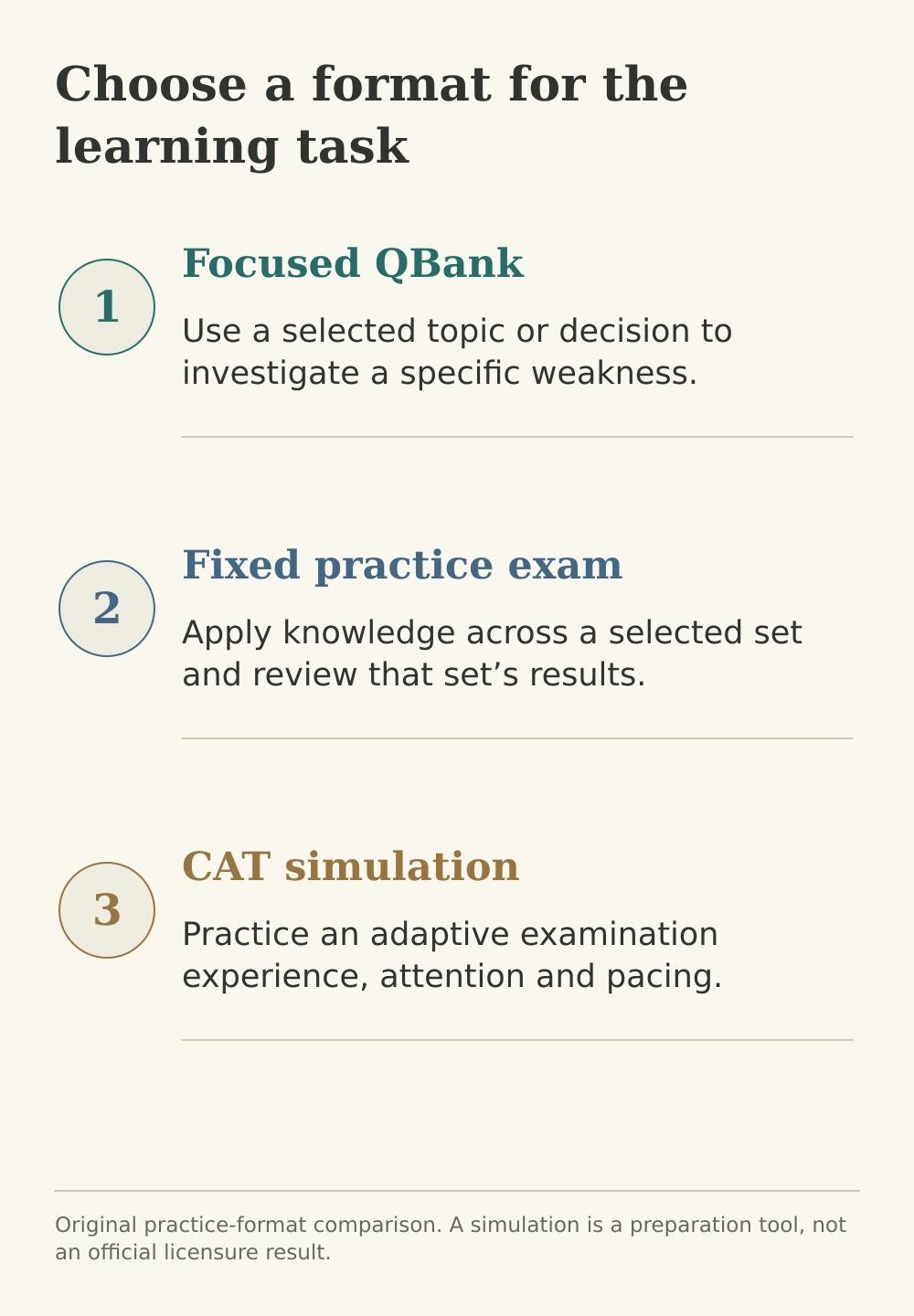
Three formats, three useful purposes
A focused QBank session: isolate and repair
A question bank is a collection of practice items. Its session settings determine the experience. Focused practice lets you work on a topic or reasoning error, read rationales and return to the underlying concept. It is well suited to learning, especially when unfamiliar content needs careful review.
A QBank is not inherently nonadaptive or untimed; some products build adaptive and exam modes from the same bank. Compare the actual session rules rather than assuming the product label tells you everything.
A fixed practice exam: hold the set steady
In a fixed exam, the question set does not change in response to your answers. It can be mixed or focused, short or long, timed or self-paced. A fixed set with feedback after every item serves a different purpose from a closed-note test with feedback only at the end.
A longer timed fixed exam can help you observe pacing and late-session errors. A self-paced fixed set can instead help you work through selected topics. Neither is automatically a validated readiness assessment, and two different fixed sets are not automatically equal in difficulty.
A CAT practice test: experience adaptive measurement
Computerized adaptive testing updates an ability estimate as responses accumulate and uses it in item selection. The official NCLEX CAT explanation also describes content requirements that shape selection. It is more complex than a guaranteed “right answer, harder question; wrong answer, easier question” pattern.
A practice CAT can provide an adaptive experience and feedback from its own measurement system. Its question pool, item calibration, scoring, content constraints and stopping rules belong to that practice product. Sharing the term CAT does not establish that it reproduces NCSBN's operational examination or its predictive accuracy.
Choose by the question you want the session to answer
- “Do I understand this concept?” Start with focused QBank work and deliberate rationale review.
- “Can I apply it outside a familiar topic?” Use fresh mixed questions or a mixed fixed exam without notes.
- “Does my reasoning deteriorate later?” Use a longer session under consistent conditions and examine where errors occur.
- “Can I tolerate uncertainty while the exam adapts?” Use a CAT simulation, then review both its report and the decisions you made.
These are ENDPEAK's learning recommendations, not official prescriptions for how many simulations to take. Make room for review. A testing session that consumes the entire study block may leave the weakness untouched.
A practical sequence instead of repeated readiness checks
Consider an original hypothetical example. A learner finishes mixed practice and notices repeated errors in patient prioritization. They switch to focused comparisons and explain why each alternative can wait. After reviewing the principles, they use unfamiliar mixed items to see whether the reasoning transfers.
Later, a longer session shows that the learner rushes at the end. The next task becomes pacing and sustained attention, not more memorization of the same priority answers. A CAT simulation then gives practice with an uncertain stopping point. Each format answers a different preparation question.
This sequence can be distributed through the adaptable study plan. There is no universal day on which every student should replace focused work with CAT exams. Your recurring errors and available review time should guide the change.
Read the report in the context of the session
Before comparing two results, check whether the items were fresh, whether hints or rationales were visible, how the content was selected and what the score measures. Percentage of items correct and percentage of available partial-credit points are different units.
Adaptive results add another consideration: candidates may receive different item mixes and difficulty levels. A raw accuracy percentage alone does not explain an ability estimate. A practice platform's “pass,” “on track” or other readiness label refers to that platform's rules, not an official NCLEX decision.
If a product publishes predictive claims, look for the study population, sample size, testing conditions and outcome validation. Do not assume that a claim applies to repeated questions, tutor-mode work or your particular background. Our QBank readiness guide examines those comparisons in more detail.
Also avoid treating a short simulated exam as proof that your real NCLEX will be short. The 85 versus 150 questions guide explains actual exam length and stopping rules. This page is about choosing practice, not inferring a real result.
How the options work in ENDPEAK
ENDPEAK's CAT Exam provides adaptive practice with a timed exam runner. Its Practice Exam creates a fixed set with selectable topics, item formats and difficulty options; it is self-paced and supports feedback and review. Do not treat that self-paced mode as though it were a standardized timed readiness test.
The QBank supports focused question work, while Performance organizes practice evidence. Use that evidence to choose the next task, not to manufacture an official probability of passing.
Explore these tools on the public ENDPEAK features page. Running study sessions requires an account and the relevant access/enrollment. No ENDPEAK practice result is an NCSBN score, certification or guarantee of licensure.
What to record after your next session
Keep a short note: format and conditions, the recurring decision error, the concept to repair and the next fresh check. That record makes a session actionable even when its headline score is disappointing.
Official CAT facts were checked against NCSBN's CAT guidance in October 2026. The format comparison, example and suggested sequence are ENDPEAK's educational framework. Product descriptions were checked against ENDPEAK's current implementation; they do not assert independently validated predictive accuracy.
ENDPEAK publishes independent NCLEX-RN study resources. Exam rules are checked against official NCSBN sources. Original teaching examples are identified as such, and clinical review is credited only when it has actually occurred. ENDPEAK is not affiliated with or endorsed by NCSBN.