A 6-Week NCLEX-RN Study Plan That Adapts to Your Weak Areas
A flexible six-week framework built around a baseline, targeted repair, fresh mixed practice and regular checkpoints—not a fixed question quota.

Six weeks is a planning window, not proof that you are ready. A recent graduate with consistent mixed-practice results and a candidate returning after a long gap may need very different schedules—even with the same test date.
This framework gives each week a purpose while leaving room to change the workload. Before committing to it, check your eligibility, authorization to test and appointment arrangements with the relevant authorities. Study progress cannot substitute for those requirements.
Set a workload you can repeat
List your available study blocks before choosing a question target. Include work, family responsibilities and recovery time. For example, five 90-minute blocks provide seven and a half hours in a week. That is an illustration of scheduling, not an official recommendation or a sufficient dose for every candidate.
A useful block includes preparation, practice and review. If you answer questions for the entire block, you have left no time to understand your errors. Reduce the number of items when rationales reveal a significant knowledge gap.
Keep an error log with four short fields: the missed decision, why you missed it, the principle you need and the date you will check it with fresh practice. Copying entire rationales can become busywork. Capture the reasoning you need to change.
Before building the schedule around an examination date, separate eligibility, registration and ATT in the NCLEX-RN registration guide.
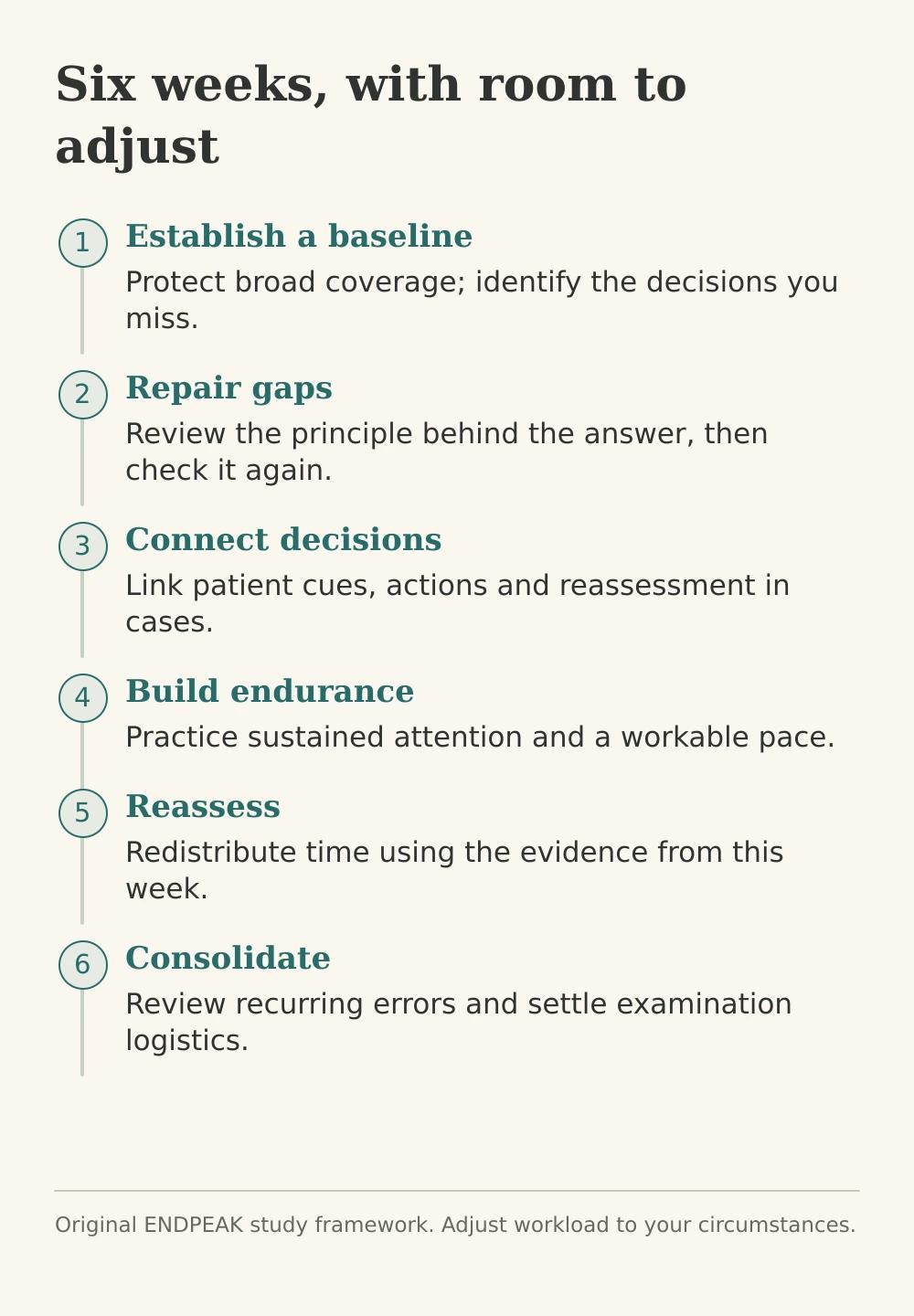
Week 1: Establish a baseline and protect broad coverage
Use fresh mixed questions to find patterns. Record whether you worked timed or untimed, whether hints were available and how many items supported each category result. Include an NGN case so that clinical judgment is visible from the beginning.
Compare the areas you practiced with the current NCSBN RN test plan. Choose two or three priorities supported by repeated errors, not just your lowest small-sample percentage. Keep all Client Needs categories on the coverage checklist.
Week 2: Repair the gaps behind your answers
For each priority, review a manageable concept and then apply it. If medication questions are weak, separate errors involving indications, adverse effects, assessment before administration and evaluation afterward. “Study pharmacology” is too broad to tell you what to do tomorrow.
End focused work with unfamiliar questions. A correct answer on an item you remember confirms recognition of that item; it does not independently demonstrate transfer to a new situation.
Week 3: Connect content with clinical decisions
Alternate targeted blocks with mixed practice. Add unfolding cases and explain how new findings change the priority. Use the six clinical judgment functions as prompts for your explanation.
Try a two-sentence review: “This finding matters because…” and “This action fits now because…”. If your rationale is simply “that is the correct answer,” you have not yet identified a reusable principle.
Week 4: Build endurance and test your pacing
Introduce longer timed mixed sessions when you can review them properly. Practice moving on from uncertain answers. Track whether concentration and reasoning deteriorate later in a session; a total score can hide that pattern.
The NCLEX-RN can run to 150 items and allows five hours including breaks, as described in the official FAQ. Prepare for the possibility of a longer exam. A practice platform's adaptive result remains practice feedback, not an official decision.
Week 5: Reassess and redistribute the remaining time
Repeat a baseline-style check with fresh questions under comparable conditions. Look for persistent error types, category coverage and clinical judgment quality. Improvement in familiar items alone is not enough reason to remove a weak area from the plan.
If two areas are now steadier but one remains weak, move more review time to that area while retaining mixed practice. If broad gaps remain, consider whether the exam date is realistic and check the applicable rescheduling rules before making changes. Do not let the calendar overrule the evidence.
Week 6: Consolidate and prepare for test day
Review a short list of recurring errors and high-priority principles. Complete enough fresh practice to confirm that you can apply them. Avoid turning the final days into an attempt to relearn every topic.
Check identification and appointment instructions, travel arrangements and a sustainable sleep routine. Plan how you will respond when a question feels unfamiliar. “Read the task, identify the evidence, choose and continue” is more useful than trying to feel certain about every answer.
Use the NCLEX test-day checklist to turn those final logistics into specific checks before leaving and at the testing center.
A simple weekly adjustment rule
- Knowledge gap: add targeted content review followed by fresh application.
- Cue or priority error: slow down the reasoning and compare plausible options.
- Instruction error: practice identifying what the item requests before answering.
- Late-session decline: examine pacing, breaks and workload as well as content.
For internationally educated nurses, include time to clarify unfamiliar U.S. nursing terminology and entry-level responsibilities. Resolve those questions with authoritative resources rather than assuming your previous setting uses identical rules.
ENDPEAK's Study Plan can organize the schedule; Initial Diagnostic and Performance can help identify what to revisit. Review the evidence behind each change. No six-week template or product score guarantees that you will pass.
Source note
Examination facts: NCSBN test plans and NCLEX FAQs. Clinical judgment framework: NCSBN model. The weekly sequence is ENDPEAK's original educational framework.
For the first-week coverage check, keep the official test plan breakdown beside your error log. During week three, use the worked NGN case guide to practice explaining decisions. At your weekly checkpoint, apply the QBank score checklist before deciding that a higher percentage means a weakness is repaired.
If you are preparing after an unsuccessful attempt, first use your Candidate Performance Report to choose specific review targets. Then adapt this schedule to those findings and your jurisdiction’s retake requirements.
ENDPEAK publishes independent NCLEX-RN study resources. Exam rules are checked against official NCSBN sources. Original teaching examples are identified as such, and clinical review is credited only when it has actually occurred. ENDPEAK is not affiliated with or endorsed by NCSBN.