NCLEX Bow-Tie Questions: Connect the Condition, Actions and Monitoring
Work through a complete original Bow-Tie teaching exercise and explain the connections between patient cues, the likely condition, actions and monitoring.
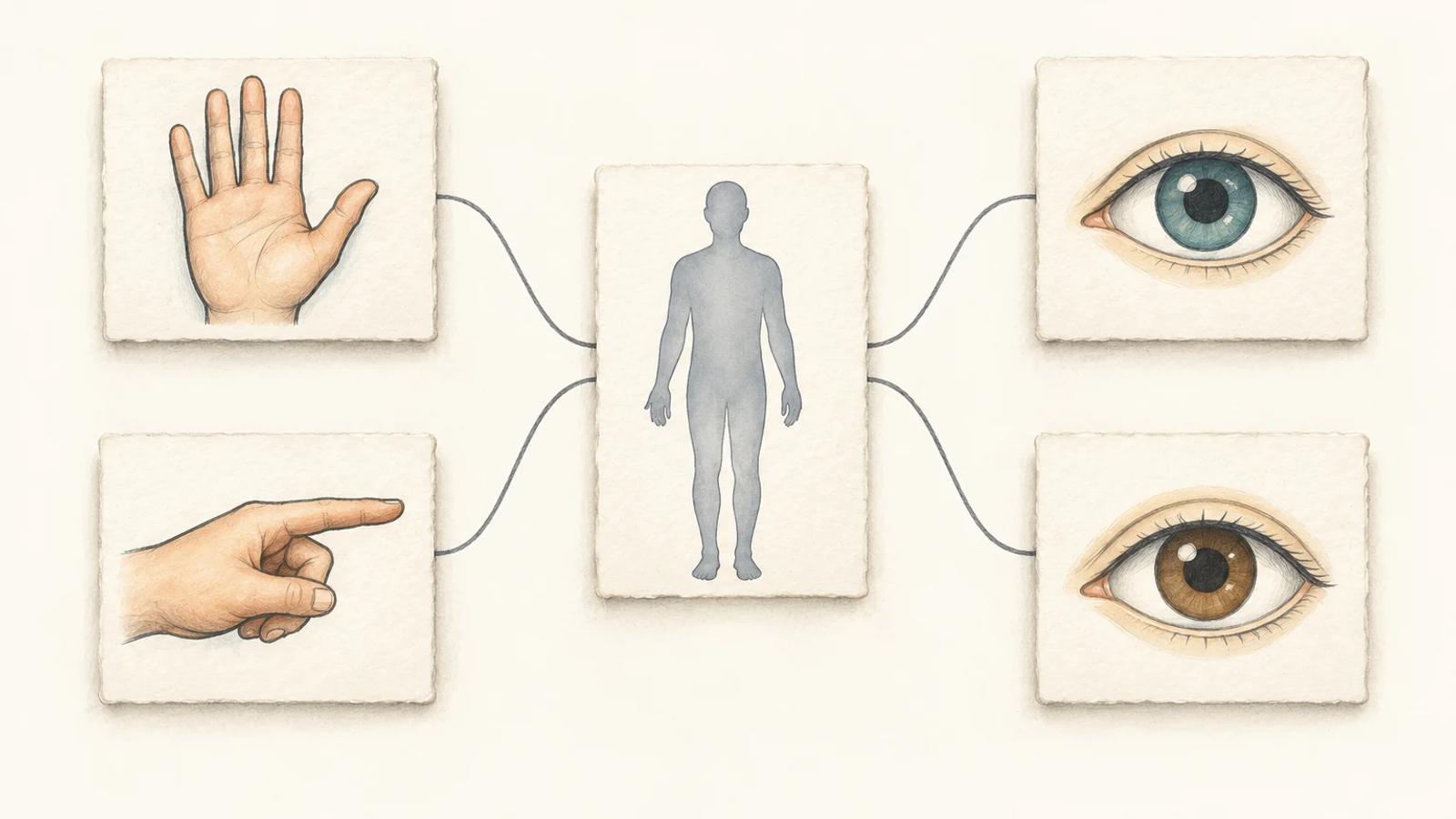
An NCLEX Bow-Tie asks for a connected set of selections: a likely condition, actions that fit it and parameters that show what happens next. In the published format discussed here, that means one condition, two actions and two monitoring parameters. Read the actual item instructions and exhibits before filling the response area.
This guide works through a complete original anaphylaxis exercise. The answer is not just a diagnosis: it has to explain why the selected actions and monitoring belong with the patient's current findings.
How the format differs from an unfolding case
The response areas have distinct jobs. A condition names the likely concern, an action responds to it and a monitoring selection identifies relevant follow-up evidence. Use the labels and available options; do not answer from the diagram's shape alone.
NCSBN describes Bow-Tie as a standalone format that brings the clinical judgment functions together within one item. That differs from an unfolding case study with several linked items. Our NGN case-study guide covers reading a changing record across several decisions; this page focuses on building one coherent set of selections.
The NCSBN Clinical Judgment Measurement Model provides the exam's framework. In practical terms, you identify relevant cues, connect them to a likely concern, select appropriate responses and decide what evidence would matter afterward. The model is not a substitute for clinical knowledge or a universal bedside algorithm.
For the official presentation of item formats, use NCSBN's sample questions and exam preview. The diagram here is ENDPEAK's original educational illustration, not a reproduction of an official item or exam screen.
Read the record before choosing the condition
Identify what is happening now. Check the time stamps, symptoms, assessment findings and recent interventions. A historical diagnosis can explain background without being the current problem. If the record includes a new event, ask whether the timing changes the likely explanation.
It helps to form a short provisional statement before comparing answer options: “New respiratory and circulatory changes followed an exposure.” That keeps one memorable word from dominating the decision. You should still test the statement against the alternatives; the first recognizable diagnosis is not automatically correct.
Next, separate what the record establishes from what you would need to investigate. Educational items provide a limited record. Do not fill its gaps with an imagined order, an unstated allergy or an assumption that every symptom has the same cause.
An original Bow-Tie practice example
Teaching record: An adult inpatient begins a prescribed IV antibiotic. Within minutes, the patient develops widespread hives, wheezing and lightheadedness. Blood pressure has fallen from 124/76 to 82/48 mm Hg. The RN is at the bedside; a second nurse has activated the emergency response. Emergency medication orders/protocols are available.
About this example: Format information was checked against NCSBN preparation resources and its clinical judgment framework in October 2026. The case, options and diagram are original ENDPEAK material, not a protected official question. Clinical support comes from the linked ASCIA, AAAAI/ACAAI and Resuscitation Council UK guidance; no independent professional nursing review has been performed.
Task: Choose one most likely condition, two actions and two parameters to monitor from the options below. Assume the nurse acts within the emergency orders/protocol and does not leave the patient unattended. This is a limited teaching exercise, not a complete emergency-care plan.
Potential condition — choose one
- Anaphylaxis
- Anxiety without a physiologic emergency
- An isolated skin reaction without systemic involvement
- A chronic blood-pressure pattern unchanged from baseline
Actions — choose two
- Stop the antibiotic infusion.
- Administer intramuscular epinephrine under the emergency order/protocol.
- Continue the infusion and reassess after it finishes.
- Ask the patient to walk to the treatment area.
- Delay emergency treatment while documenting a complete medication history.
Parameters to monitor — choose two
- Respiratory status and oxygenation
- Blood pressure
- Long-term glycemic control
- Daily calorie intake
- Routine bowel pattern
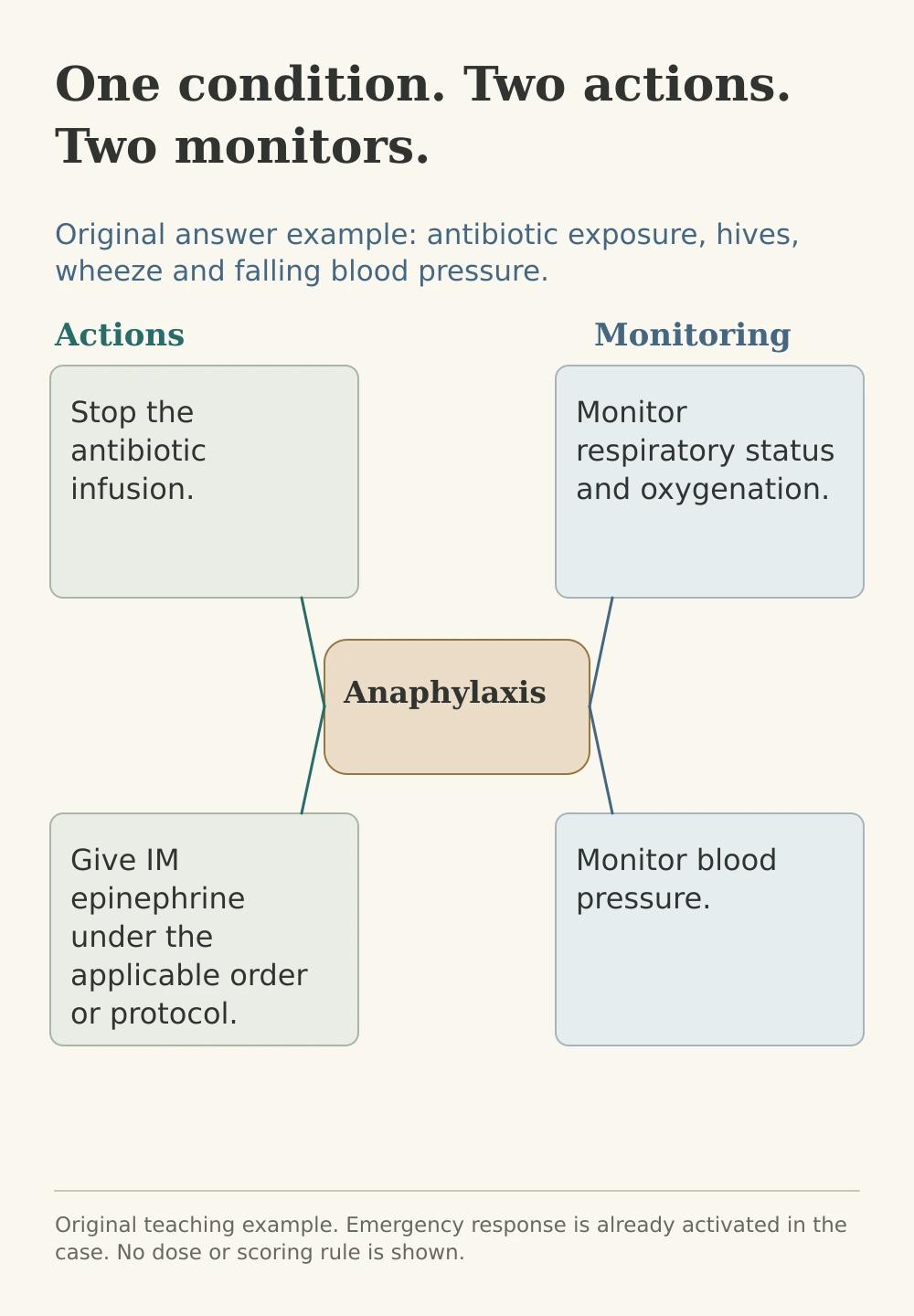
The selected answer is illustrated below. Before reading the explanation, name the patient evidence supporting the center, then explain why each side belongs with it.
Work through the connections
The center: why anaphylaxis fits
The important pattern is rapid onset after a medication exposure, skin findings, breathing involvement and a substantial blood-pressure fall. Together, these support anaphylaxis. Anxiety does not explain away those physiologic findings. An isolated skin reaction does not account for the respiratory and circulatory changes.
The ASCIA acute-management guidance, updated in 2026, describes these multisystem features. In this example, the likely condition follows from several connected cues; it is not inferred merely from the word “antibiotic.”
The actions: respond to the immediate problem
Stop the infusion removes an ongoing suspected exposure. Intramuscular epinephrine under the emergency order/protocol addresses anaphylaxis. The AAAAI/ACAAI practice parameter identifies epinephrine as first-line treatment and emphasizes avoiding delay.
Continuing the infusion or postponing response until the documentation is complete fails to address the emergency. Walking a hypotensive patient to another area is unsafe. The stem already supplies emergency activation so that the two selected actions do not imply the nurse should manage this alone.
Real emergency care also involves positioning, airway support, other indicated treatment and reassessment. These depend on the actual situation and protocol. A Bow-Tie's limited number of selections does not turn its answer into an exhaustive care plan. No doses are provided in this educational example.
The monitoring: look for response and deterioration
Respiratory status/oxygenation and blood pressure directly address the breathing and circulatory problems described. Those findings can help evaluate response and identify ongoing deterioration. The Resuscitation Council UK guideline includes these monitoring measures in anaphylaxis care.
Calorie intake and bowel pattern may matter in other care, but they do not measure the immediate threat in this record. Long-term glycemic control addresses a different timescale. A parameter should help answer a specific follow-up question: “What would show whether this problem is improving or getting worse?”
A practical sequence for an unfamiliar Bow-Tie
First, read the instructions and all relevant exhibits. Identify the current cues and form a provisional explanation. Compare the conditions against that evidence before settling on the center.
Then evaluate actions for fit, timing and safety. An action may be appropriate for the condition at some point but inappropriate now. Teaching, discharge planning and documentation can be necessary without being the best immediate selections.
Finally, select monitoring that can detect a meaningful response or complication. Recheck the full set. If an action or parameter makes sense only for a different condition, revisit the mismatch rather than keeping it because it sounds like good nursing care.
This sequence is a study aid, not an official required answering order. If the actions help clarify the likely condition, use them as evidence—but verify that the patient record supports the resulting interpretation.
Common errors worth recording
Choosing a diagnosis from one cue. A single abnormal finding may have several explanations. Practice writing a brief evidence statement with the most relevant associated cues.
Selecting generally useful care instead of the requested care. Explain why an option is appropriate at this point in the record. “The nurse should educate patients” does not justify making education the immediate response to a physiologic emergency.
Confusing intervention with outcome. Giving a medication describes an action. A changing assessment or measurement provides evidence about the patient's response. Practice connecting each intervention with what you would reassess.
Importing SATA scoring assumptions. Follow the Bow-Tie selection requirements. This guide does not assign an official point formula or treat its teaching example as a validated scoring instrument. The SATA and partial-credit guide explains why response formats cannot all be scored using the same shortcut.
Rebuild the Bow-Tie without its answer
Cover the selected diagram. For this case, write one condition, two actions and two monitoring selections, then add the patient evidence supporting each connection. Do not look for five generally sensible phrases: the selections need to explain this event.
For a follow-up session, ENDPEAK's QBank and Practice Exam provide access to NGN practice and review with an account and appropriate enrollment. Choose a format deliberately using the practice-mode comparison, rather than using a longer session to avoid an unresolved connection.
Finish with one countercheck: why is the option “an isolated skin reaction” inadequate here? Your explanation should account for the wheezing and blood-pressure fall. If it describes only the hives, reconsider the center before defending the wings.
ENDPEAK publishes independent NCLEX-RN study resources. Exam rules are checked against official NCSBN sources. Original teaching examples are identified as such, and clinical review is credited only when it has actually occurred. ENDPEAK is not affiliated with or endorsed by NCSBN.