How to Answer NGN NCLEX Case Studies: A Step-by-Step Guide
Work through an original unfolding hypoglycemia example to connect cues, hypotheses, actions and reassessment across the six clinical judgment functions.

An unfolding case asks you to make several decisions about the same patient. The challenge is keeping those decisions connected while new information arrives. If you answer each screen as an isolated question, you may overlook a trend or carry an old assumption into a changed situation.
The NCSBN clinical judgment model identifies six functions: recognize cues, analyze cues, prioritize hypotheses, generate solutions, take action and evaluate outcomes. Use those functions as reasoning prompts. They are not a shortcut that replaces clinical knowledge.
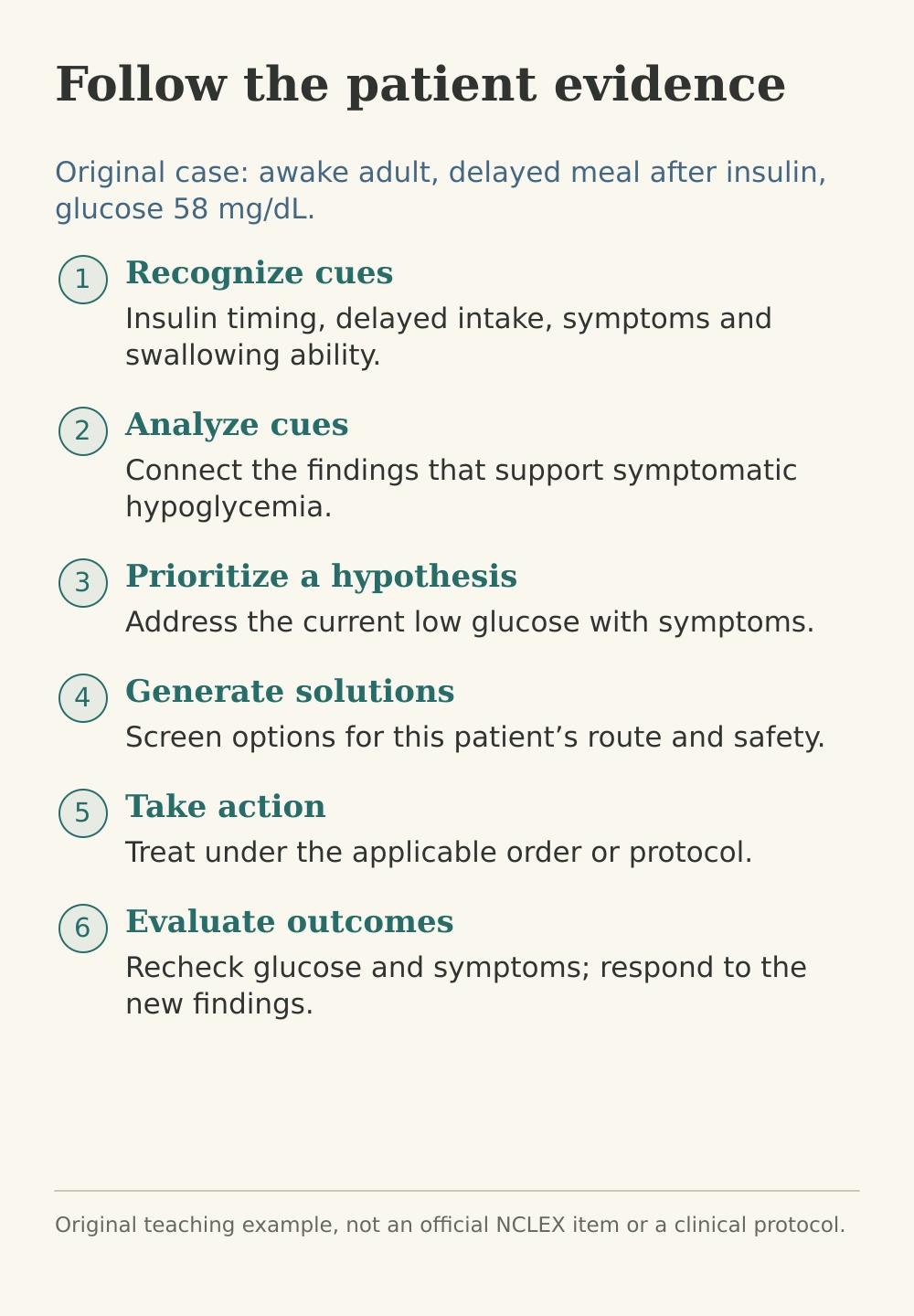
An original case to practice the reasoning
Teaching case: An adult inpatient with diabetes received prescribed rapid-acting insulin with breakfast expected shortly afterward. The meal was delayed. The patient now reports shakiness and hunger and appears sweaty. They are awake, oriented and able to swallow. A bedside glucose measurement is 58 mg/dL.
This fictional scenario was created by ENDPEAK for education. It is not an official NCLEX question and has not received independent professional nursing review. In clinical practice, follow institutional protocols, orders and escalation procedures.
Step 1: Recognize cues—select what changes the decision
Relevant cues include the insulin timing, delayed food intake, symptoms, glucose value and ability to swallow. The swallowing assessment matters because it affects which treatment route is safe. “The patient has diabetes” provides context, but it is less immediately useful than the current measurement and symptoms.
Before selecting an answer, separate observed facts from guesses. You know the meal was delayed. You do not know that the patient deliberately skipped it. Do not add a story that the case has not given you.
Step 2: Analyze cues—connect them rather than count them
Low glucose, symptoms and insulin without timely food point in the same direction. The combination supports hypoglycemia as a current concern. The CDC identifies glucose below 70 mg/dL as low.
Ask which findings explain each other and which would weaken your interpretation. A later normal glucose reading with continuing symptoms would require reassessment rather than an automatic repeat of the original explanation.
Step 3: Prioritize hypotheses—name the concern that needs attention now
The immediate concern is symptomatic hypoglycemia. Improving routine meal scheduling is also relevant, but it does not replace treating the present problem. A good priority statement includes both the concern and the evidence: “Low glucose with symptoms after insulin and delayed intake requires prompt treatment.”
Avoid choosing a broad label such as “diabetes management” when the case supports a more specific, time-sensitive problem.
Step 4: Generate solutions—screen for safety and fit
For this awake adult who can swallow, a fast-acting carbohydrate is a relevant option. The CDC's 15–15 guidance is to take 15 grams of carbohydrate, wait 15 minutes and recheck; repeat if glucose remains below 70 mg/dL. After recovery, a balanced meal or snack with carbohydrate and protein helps maintain glucose.
Route matters. Do not give oral carbohydrate to a patient who cannot swallow safely or is unconscious. That different presentation calls for emergency treatment and escalation according to protocol. A familiar intervention is not safe merely because it worked in a different case.
Step 5: Take action—answer the task actually asked
If the task asks for an immediate action, treating the low glucose under the applicable protocol addresses the current problem. Teaching about preventing future episodes belongs later. If it asks which additional assessment is necessary, an action-only answer may miss the task.
Read the selection instruction carefully. “Select two” and “select all that apply” are different constraints. Evaluate each option against the current case; do not select an option only because it is generally good nursing care.
Step 6: Evaluate outcomes—look for evidence, not completion
New teaching-case data: after treatment, a repeat glucose measurement at 15 minutes is 92 mg/dL and the shakiness and sweating have resolved. These findings support an initial response. Continue monitoring and address the delayed intake according to the care plan.
“Carbohydrate was given” describes an intervention. “Glucose improved and symptoms resolved” describes an outcome. If the repeat measurement remained low, you would need further action and reassessment rather than marking the problem resolved.
Read an unfolding record without losing the timeline
At each update, pause for three checks: What is new? What earlier finding still matters? Does the new information change my priority? A brief mental timeline helps distinguish a current result from an older one.
When reviewing practice, explain your answer in one sentence that cites patient evidence. Then explain why the most tempting alternative is less appropriate now. If you cannot do either, revisit the rationale before attempting another case.
Partial credit does not mean casual selection
NGN scoring varies by item type. The official FAQ describes plus/minus, zero/one and rationale scoring. Some formats can deduct points for incorrect selections, with an item score floor of zero; linked rationale responses require the correct relationship. Do not assume that selecting extra answers improves your score.
Use ENDPEAK's NGN Questions and QBank to practice one reasoning function deliberately. For example, spend a session explaining why a cue is relevant before focusing on speed. Accuracy of reasoning comes first; fluency develops through well-reviewed practice.
References
NCSBN clinical judgment model; NCLEX scoring FAQs; CDC: Treatment of Low Blood Sugar. Case details and teaching explanations are original ENDPEAK material.
To choose which case topics to practice next, compare your gaps with the 2026–2029 RN blueprint. Then place case practice alongside focused review in the six-week study framework, rather than saving clinical judgment for the final days.
For item-level scoring, read our SATA and partial-credit explanation; scoring depends on the response format. To strengthen the urgency comparisons behind a case decision, work through the original scenarios in our NCLEX prioritization guide.
For a standalone item that connects a condition with actions and monitoring, work through the original example in NCLEX Bow-Tie Questions.
ENDPEAK publishes independent NCLEX-RN study resources. Exam rules are checked against official NCSBN sources. Original teaching examples are identified as such, and clinical review is credited only when it has actually occurred. ENDPEAK is not affiliated with or endorsed by NCSBN.