NCLEX SATA Questions and Partial Credit: How Scoring Really Works
Learn how SATA earns partial credit, how incorrect selections affect points and why Select N and rationale-scored items follow different rules.

Yes, current NCLEX select-all-that-apply questions can earn partial credit. But “partial credit” does not mean every extra selection helps. In a SATA item scored with plus/minus, an incorrect selection can cancel a point earned by a correct one.
The useful question is not how many boxes to check. It is which options the patient information and the task actually support.
SATA and Select N ask different things
SATA means select all that apply. You evaluate multiple options and select every option that answers the question. NCSBN's current SATA guidance confirms that traditional multiple-response SATA items use plus/minus scoring. Older advice describing these items as entirely all-or-nothing is outdated.
A Select N item specifies a number, such as “select three.” That instruction matters: you cannot treat it as open-ended SATA. Select N uses zero/one scoring, with credit for correct choices and no subtractive penalty for an incorrect choice. You still have to choose the stated number; a wrong choice occupies a place that could have earned credit.
Read the instruction before judging the options. “Find all relevant findings” and “select the three findings requiring immediate follow-up” may require different selections even when they use the same chart.
A small example makes plus/minus clearer
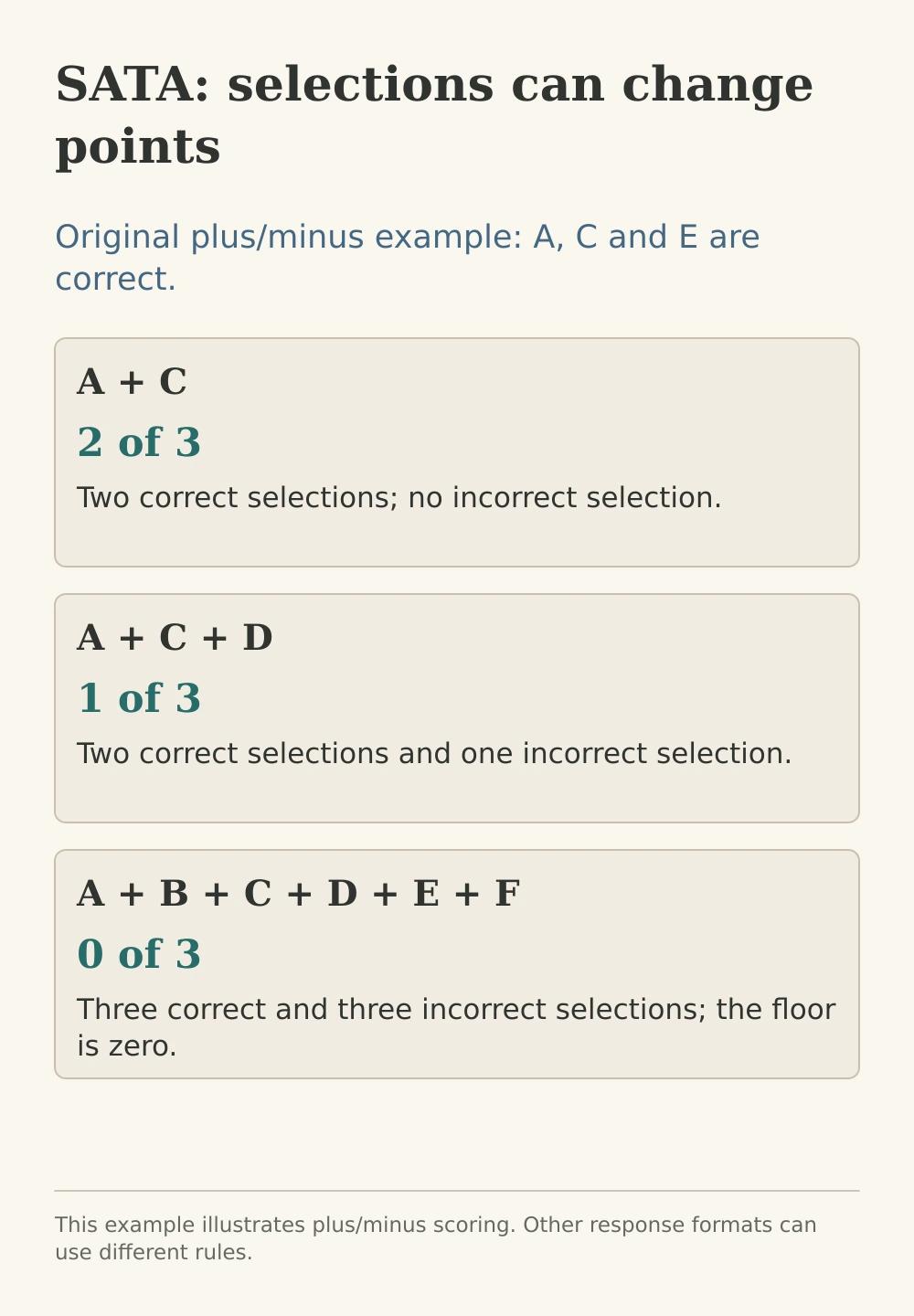
This is an original scoring illustration, not a clinical question or an official NCLEX item. Imagine six options, A through F. The answer key contains A, C and E, so the item has three possible points.
- Select A and C: two correct selections, no incorrect selections. The score is 2 of 3.
- Select A, C and D: two correct selections minus one incorrect selection. The score is 1 of 3.
- Select all six: three correct selections minus three incorrect selections. The score is 0 of 3.
- Select B, D and F: no correct selections and three incorrect selections. The item score is floored at 0, not negative three.
Leaving out E in the first example loses the opportunity to earn its point. Adding D in the second example actively reduces the earned score. Those are different kinds of error, and your review should distinguish them.
The floor applies to this item. It does not mean guessing becomes useful, and it does not create a negative balance carried into the next question. These points also cannot be converted into a universal percentage you must achieve to pass the adaptive examination.
Where the other scoring methods fit
The 2026–2029 RN test plan names three partial-credit methods. They are assigned to suitable item structures; they are not interchangeable rules for every SATA question.
Zero/one: credit for correct response components
Under NCSBN's scoring-model explanation, examples include Select N and matrix multiple-choice items. In the latter, rows are scored separately and their points are added. A matrix multiple-choice item is not the same as a matrix multiple-response item, which can use plus/minus.
Illustrative Select N example: if the task requires three choices and two of your three are correct, you earn two points. The incorrect choice earns zero rather than subtracting a point. Do not transfer that rule to an unrestricted SATA item.
Rationale scoring: the connection must be correct
Rationale scoring applies to linked information, such as an action paired with the reason for it. Both components of a scored pair must be correct. Recognizing an appropriate action without correctly connecting its rationale does not earn that pair's point.
That is why you should check the relationship, not just whether each phrase sounds familiar. In an unfolding case, new information may change which explanation fits. Our NGN case-study guide works through those changing decisions.
Evaluate each option against the exact task
For each option, make yourself finish one sentence: “This belongs because…” or “This does not belong because…”. Name the cue, nursing principle or safety issue supporting your judgment. “It sounds medical” is not enough.
Then check the time frame. An intervention might be appropriate later without answering a question about immediate action. A true statement about a condition might not describe this patient's current findings. Conversely, two correct options may address different parts of the same problem; selecting one does not automatically make the other redundant.
Pay particular attention to qualifiers. If an option says to take an action regardless of the patient's status, decide whether that absolute instruction is supported. Avoid rejecting an option solely because it contains an absolute word; judge the actual clinical claim.
There is no defensible universal quota such as “always select two,” “never select more than three” or “pick everything unless you are certain it is wrong.” The right number follows from the options and evidence. When uncertainty remains, decide using the information given rather than inventing an unseen symptom to justify a choice.
Review selections, not just the item result
After practice, separate three patterns: correct options you recognized, correct options you missed and incorrect options you added. Record the reason behind the misses and additions. Missing a cue may call for content review; adding an action at the wrong time may call for prioritization practice.
A useful next session revisits the principle through unfamiliar questions. Rechecking the same answer key can help learning, but it is weaker evidence of transfer. Use the QBank score guide before comparing practice percentages that use different scoring units.
ENDPEAK's QBank and NGN practice tools provide a place to apply this review approach. Study-tool access requires an account and the applicable access permissions. Read the rationale for each choice instead of treating a partial score as proof that the reasoning is complete.
Sources and scope
Exam rules checked in October 2026: NCLEX FAQs, NCSBN traditional SATA FAQ and NCSBN scoring models. The lettered examples and study method are ENDPEAK's original teaching material. They explain item-level scoring, not an official pass-probability calculation.
ENDPEAK publishes independent NCLEX-RN study resources. Exam rules are checked against official NCSBN sources. Original teaching examples are identified as such, and clinical review is credited only when it has actually occurred. ENDPEAK is not affiliated with or endorsed by NCSBN.