Failed the NCLEX-RN? Turn Your Candidate Performance Report Into a Retake Plan
Use CPR labels to select concrete review targets, maintain stronger areas and plan a retake after checking your nursing regulatory body’s requirements.

A failed NCLEX-RN result tells you that your overall performance did not meet the examination's passing requirement. It does not tell you to start every subject from zero. Your Candidate Performance Report can help you choose where to begin—provided you use it as feedback, not as a hidden numerical score.
Put the report beside a blank study log. The goal is to turn broad performance labels into specific nursing decisions you can practice and reassess.
What the Candidate Performance Report contains
NCSBN describes the Candidate Performance Report, or CPR, as individualized feedback for candidates who do not pass. It covers test-plan content areas and clinical judgment, using Below, Near and Above the Passing Standard. Your nursing regulatory body sends the report; contact that body if you need help obtaining it.
If you did not answer the minimum number of items, the abbreviated CPR reports the number answered and the minimum needed for evaluation. It does not supply the full diagnostic breakdown. Without those ratings, use fresh broad practice and a qualified educator's guidance to investigate gaps; do not invent missing CPR results.
Read the labels without turning them into grades
Below the Passing Standard: make this a first review priority. Near the Passing Standard: it remains a review target, not proof that you passed that area. Above the Passing Standard: maintain the knowledge while devoting more repair time to weaker areas.
The NCLEX is not passed section by section. The overall examination determines the outcome. You cannot count Above labels, assign percentages to them and calculate a pass probability.
The official sample RN report explicitly distinguishes Near from at-or-above performance. Its ratings describe performance within the relevant domain; they do not reveal precisely how many questions you missed or how close the entire exam was to passing. The public sample is dated 2023, so use your own current report for its headings and the 2026–2029 RN blueprint for current content planning.
Clinical judgment feedback deserves its own attention. A weakness in prioritizing hypotheses or evaluating outcomes may recur across several content areas. Reading more pages about the diagnosis will not necessarily repair the decision step that you keep missing.
An original example: from three labels to useful work
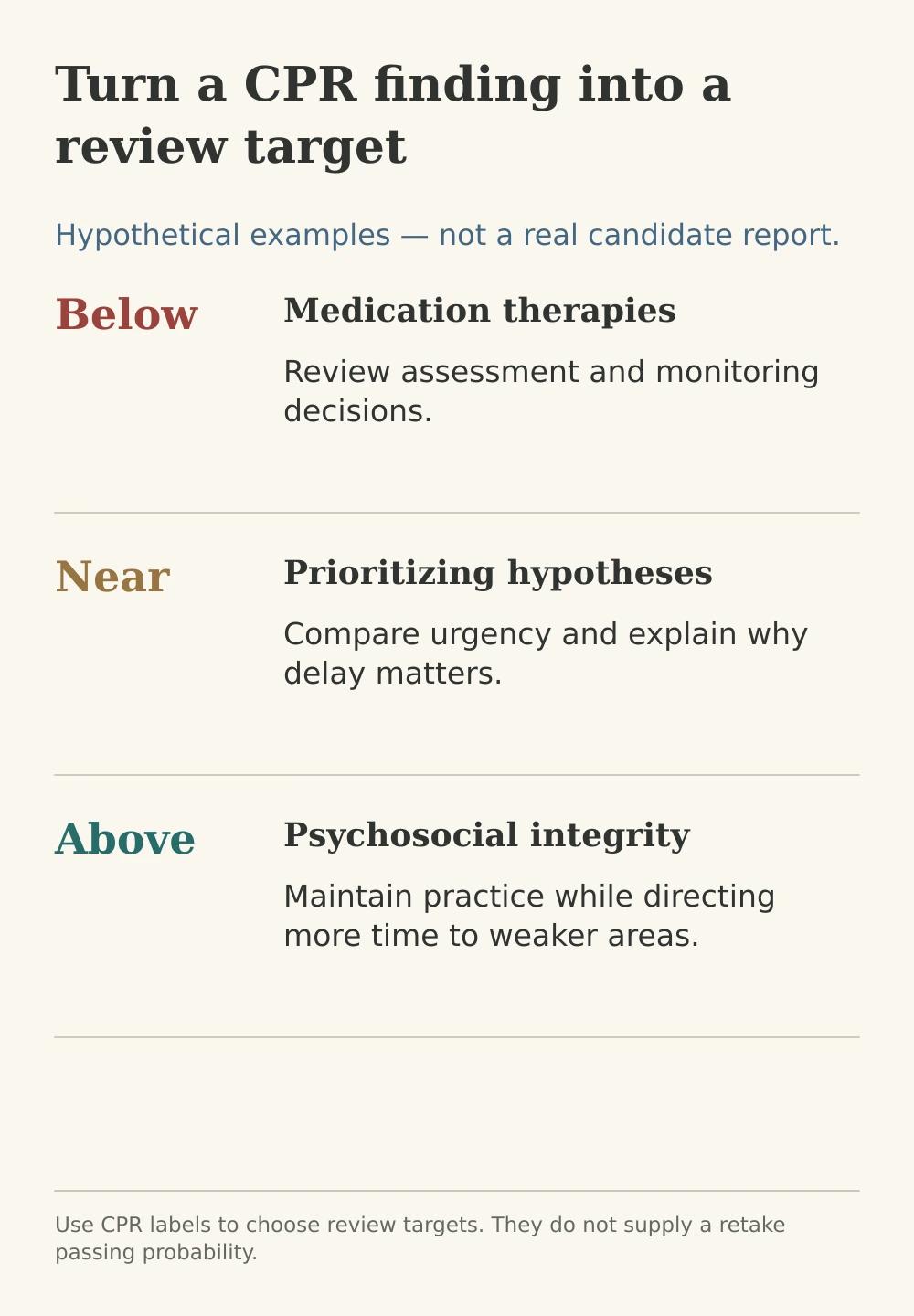
The following pattern is hypothetical. It is not an actual candidate's report, an official NCSBN sample or a prediction model. Imagine Pharmacological and Parenteral Therapies is Below, Prioritize Hypotheses is Near and Psychosocial Integrity is Above. These are only three selected lines; they do not represent a complete CPR.
Below: investigate the medication decisions
“Review pharmacology” is too large to schedule. Begin with a manageable sample of unfamiliar medication questions. Categorize each error: indication, important assessment, adverse effect, administration safety, teaching or evaluation.
If several errors concern monitoring rather than drug identification, the next block should connect effects with relevant observations. Review one family, explain the monitoring in your own words and apply it in new questions. Use our pharmacology review guide for that process.
Near: practice the comparison behind the priority
For each priority item, explain the finding that makes delay unsafe and why the alternatives are less urgent. A missed answer might reflect weak content, but it might instead reflect ranking by diagnosis rather than the current change.
Practice the same decision step in different topics. If the priority explanation becomes sound in one familiar scenario but breaks down in another, continue the work. Our prioritization guide shows how changing a cue changes a ranking.
Above: keep maintenance in the rotation
Maintain Psychosocial Integrity through mixed practice and brief review of errors. An Above label describes that exam performance; it does not guarantee that the area will stay strong or that future practice needs no attention.
Continue coverage across the full blueprint. This three-line example chooses repair priorities; it does not remove the remaining categories from the plan.
Make the next week small enough to evaluate
Write three concrete tasks rather than a sweeping promise to study harder. For the hypothetical pattern, those tasks could be one focused medication review, one set of patient-priority comparisons and one broad mixed session including the areas you want to maintain.
Beside each task, write what you will look for afterward: fewer missed monitoring cues, clearer urgency comparisons or successful application on fresh items. Keep repeated questions separate from unfamiliar ones. Our QBank score guide explains why a rising percentage alone can mislead.
At the weekly checkpoint, ask whether the same reasoning error returned. If it did, change the repair—not simply the number of questions. If the finding is inconsistent, gather more comparable practice before declaring the area fixed. A qualified nursing educator can help when you cannot identify why an error persists.
Use the adaptable six-week study framework to arrange those tasks around your available time. The CPR selects priorities; the calendar organizes work. Neither determines your eligibility or guarantees readiness.
Check retake eligibility before choosing a date
The NCSBN retake policy permits eight examinations a year for participating jurisdictions, with at least 45 test-free days between attempts. Some nursing regulatory bodies require longer waits or impose stricter attempt limits. Do not assume the earliest possible date applies to your situation.
Contact the regulatory body where you are seeking licensure about reapplication, fees, required materials, remediation rules and eligibility. Then reregister with Pearson as instructed, receive a new Authorization to Test and schedule within its validity dates. The current Candidate Bulletin explains the administrative process.
For internationally educated nurses, confirm that the relevant documentation and eligibility requirements remain satisfied with your chosen regulatory body. Studying in another country does not replace that jurisdiction's requirements.
Use the report to decide, then use practice to check
You do not need to reconstruct the real examination or collect remembered questions. Work from the CPR, current references and original practice material. Choose a specific gap, repair it and test the reasoning in a new context.
ENDPEAK's Study Plan and RN Topics can help organize that work; an Initial Diagnostic can provide additional practice evidence. Study tools require an account and applicable access. ENDPEAK does not replace the official CPR or your regulatory body's retake decisions.
Source note: official CPR guidance, sample RN CPR, NCLEX results/retake guidance and the April 2026 Candidate Bulletin were checked in October 2026. The repair example and weekly tasks are ENDPEAK's original educational suggestions.
ENDPEAK publishes independent NCLEX-RN study resources. Exam rules are checked against official NCSBN sources. Original teaching examples are identified as such, and clinical review is credited only when it has actually occurred. ENDPEAK is not affiliated with or endorsed by NCSBN.